
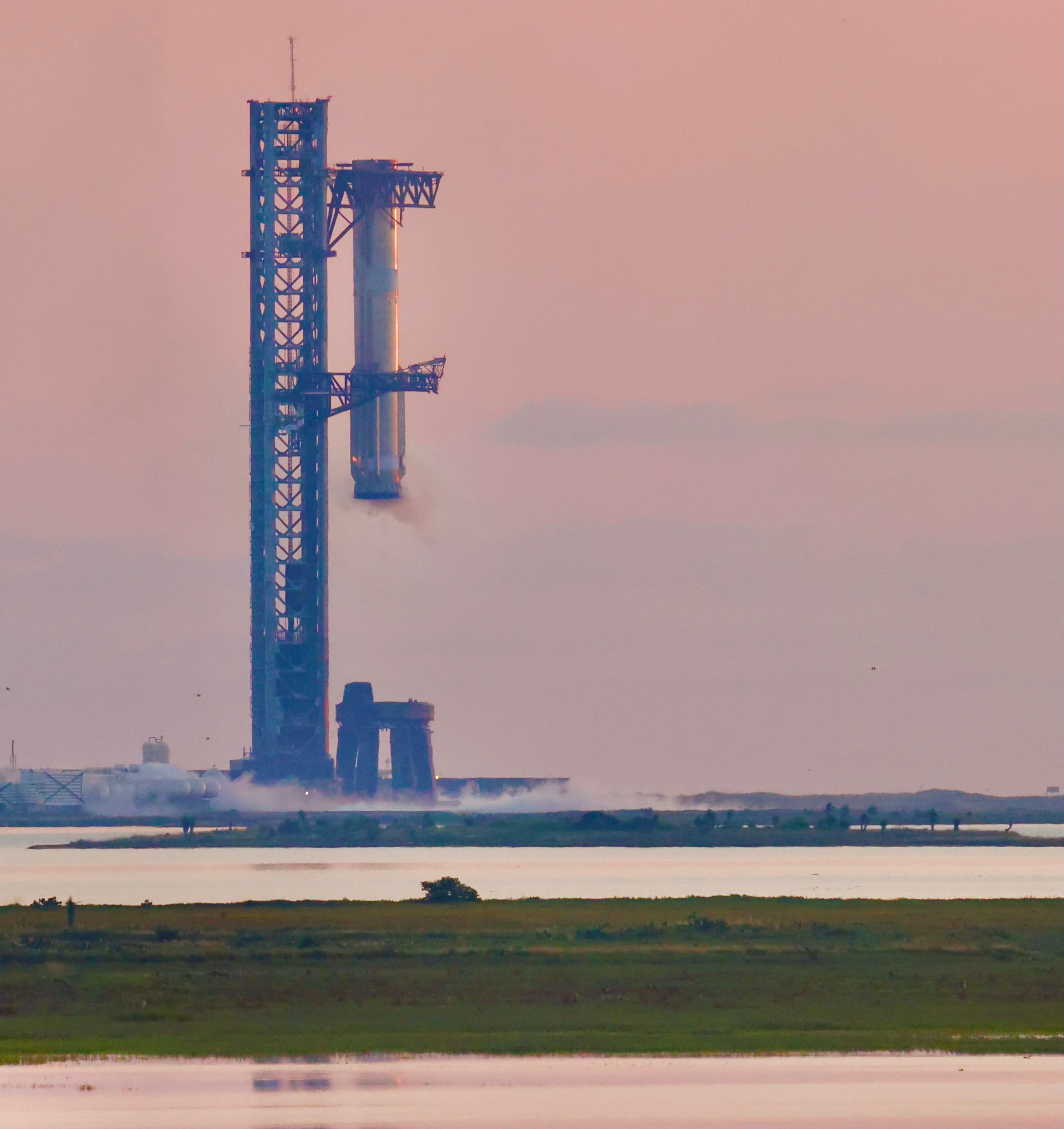
Tuesday
Before the market opened this morning, index funds had to buy roughly $4 billion of SpaceX.
Nobody made a specific decision to do so. No analyst judged the price fair. No fund manager weighed the company’s $5 billion loss last year against its brilliance. No retirement saver was consulted. The purchase was settled on June 26, when Nasdaq announced that SpaceX — a public company for all of two weeks — would join the Nasdaq-100.1
I should be transparent about where I stand on this trade, because this time that disclosure is the story. Vera and I invested in SpaceX years ago, with our eyes open and with money we could afford to lose. I liked the bet enough that I invited friends into it with me. A companion essay to this one grants the company’s brilliance at length. I placed that bet, and I would place it again.
This essay, though, is about the difference between placing a bet and being handed one — because this morning, the people on the other side of the trade from me and my friends were 150 million Americans who probably will have no idea they just became SpaceX shareholders.2
How does a stock this new get into a flagship index at all?
It used to be impossible: the long-standing eligibility rules required a new listing to season in the market for months or years before an index would touch it. This spring the exchange rewrote the rules — proposed in February, adopted in March, in force by the first of May — so that a large enough company could qualify almost at once. SpaceX, the largest IPO in history, had been public for fifteen trading days when it entered the index this morning.3 The list changed, and the more than $800 billion that tracks the list had to change with it — about $4 billion of buying on the first morning alone, at whatever the price happened to be.
And Tuesday is only the first installment. SpaceX is one of the ten most valuable companies in America, but an index buys by the share count actually available to trade — and most SpaceX shares are still locked up in the hands of insiders and early investors, with the first release dates already on the calendar. As the lockups expire and those shares come to market, the company’s float grows, and its index weight grows with it, and those funds must buy again. Automatically. Every future insider sale, including from me and my friends, lands in a market where the buyer has already been assigned.
If you have a retirement account, that buyer is probably you.4
Autopilot
To understand why none of that money can decide to forgo purchasing SpaceX stock, you have to know why it stopped having an active manager and instead has an algorithm.
For half a century, evidence piled up that professional stock-pickers, as a class, could not beat the market by enough to cover their own fees. The verdict arrived slowly and then completely: you might trust their judgment, but you’d still lose because of the cost of that judgment.
So money did the rational thing — it fired the judgment. Today more than half of the money Americans keep in funds sits in index funds, which own whatever the index, or list, says, in the proportions the index says, and at any price.5 It was the right answer to a real problem, and it produced something new in the history of markets: trillions of dollars moving by algorithm with no opinion overriding it.
The last human hand left in the machine belongs to the committees that write the lists. Which is why a rule change at one exchange can automatically redirect billions of dollars of other people’s savings in a morning — the autopilot flies wherever it is pointed.
The Ante
Whose money does that autopilot control?
You take a job. Somewhere in the onboarding packet, you are enrolled — and since 2006 the law has encouraged your employer to do it automatically, and almost nobody opts out, for the same reason almost nobody reads the packet.6
A percentage of your paycheck is chosen for you. A target-date fund is chosen for you, and inside it resides the index. From then on, every two weeks, for the rest of your working life, the money goes in — rain or shine, bull or bust, from 150 million people who cannot leave without penalty before the law’s strange half-birthday of fifty-nine and a half, and who have been told over and over again that pulling back is the most irresponsible thing they could ever do.7
Poker has a word for money like that — the stake you must post before the cards are dealt, the payment that buys you no choices and simply makes you part of the hand.
The ante.
You think of yourself as an investor. But an investor is someone who decides. You are the ante: the guaranteed money, arriving on payroll schedule, that makes the whole game worth dealing for the people who actually hold cards.
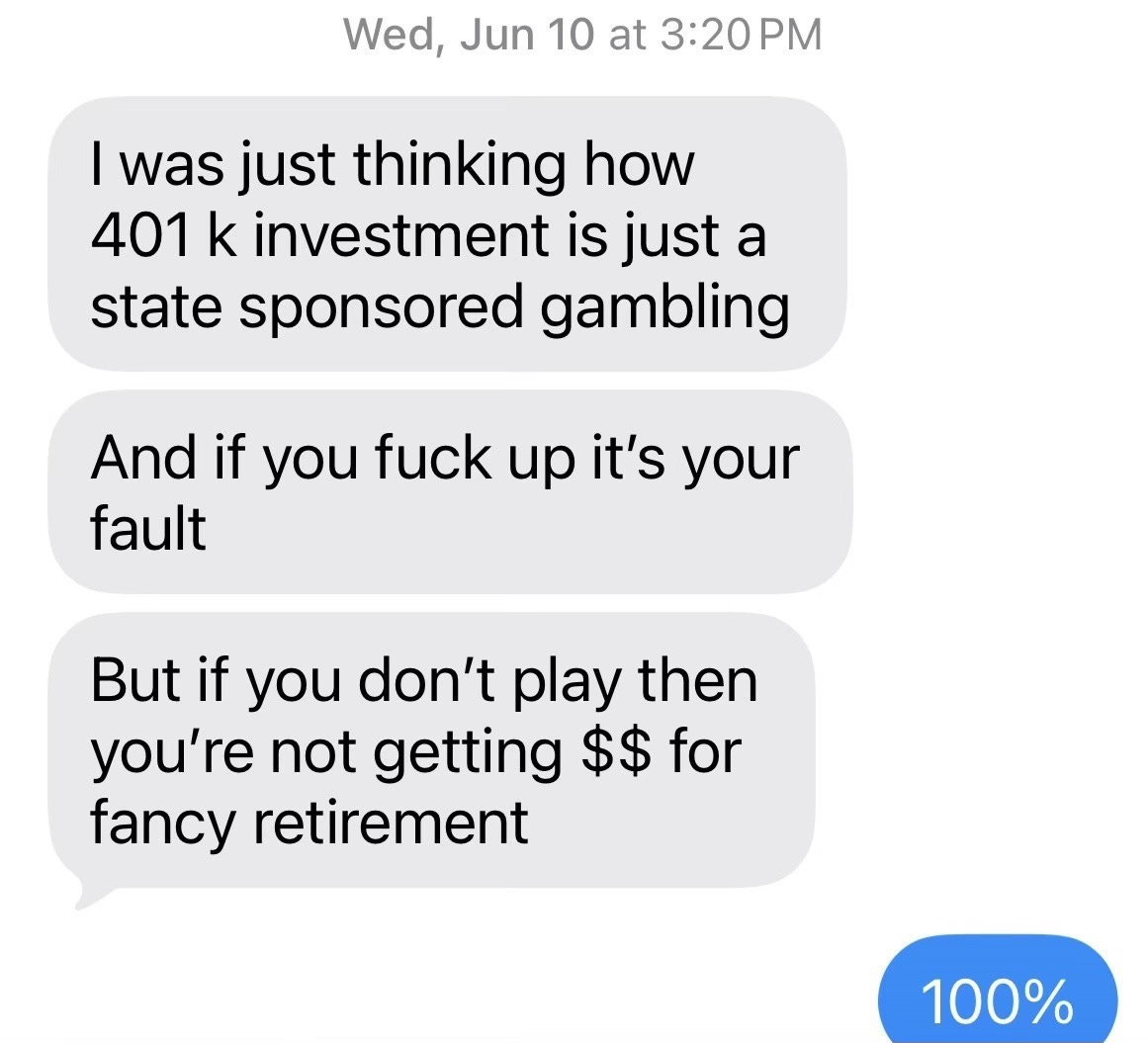
Vera saw it first — sixteen days before Nasdaq moved. On a Wednesday afternoon in June, she texted me unprompted:
I was just thinking how 401k investment is just state sponsored gambling.
Then:
And if you fuck up it’s your fault.
Then:
But if you don’t play then you’re not getting money for a fancy retirement.
I texted back the only honest response: 100%.
Sixteen days later the exchange that runs the game proved her right on schedule.
Her three texts describe the design of modern markets. Consider how the state treats two different forms of gambling houses. The casino is licensed grudgingly: heavy taxes, warning posters, and a hotline number stapled to the door. The retirement account is treated the opposite way: it shelters the account from taxes, signs the players up automatically, and fines anyone who leaves the table early. But the losses are still yours. Sitting out is the one move the design does not really allow, because who wants to turn down free money and favorable taxation?
The difference between the casino and the retirement account is not the odds. It is that the casino has to persuade you to come play.
One more symmetry, and Vera’s insight is complete.
SpaceX is itself a child of the state — saved in 2008 by a NASA contract when it was weeks from dying, then carried for years by government launches and government broadband.8 So follow the money all the way around: a company rescued by public contract, and ultimately fast-tracked by a privately written rule into a pool of savings the state builds, subsidizes, and fines you for leaving. Vera’s word was more precise than she knew.
Sanctioned, at every layer.
The Private Room
And notice — this morning especially — who has been holding the cards.
Every casino has a room the floor never sees. To buy SpaceX at any point in the twenty-four years before its IPO, the law required you to be an accredited investor, which mostly means already rich by any normal standard.9 The stated purpose is to protect you: private offerings are too risky for ordinary people.
But money was only the cover charge. Seats at a table to invest in deals like SpaceX are never advertised. They pass hand to hand, as favors, among people who already know each other. I know exactly how this works, because I did it: my seat came through a friend, and I pulled up chairs for other friends. Nobody in the private room experiences this as gaming anything. It feels like generosity, because it is — generosity among the people already in the room. That is what access actually is.
Protection, it turns out, means being spared the risks you might rationally choose and then automatically enrolled in the ones you probably would not.
Because when the private room decides it is time to cash out — which is what going public means nowadays — the shares have to land somewhere. This morning they landed on the main floor: delivered by rule into the target-date funds of people who will learn what they own, if ever, from a statement they would have to dig deep to ever find. The demand is scheduled, without even the pretense of persuasion. And it will be there again at every lockup expiration, absorbing every insider sale at whatever the price is that day, without those buyers deciding anything.
The index rules, the auto-enrollment, the fee revolution, the committee’s update — every piece was somebody’s genuinely good answer to a real problem. But the sum of all that local sense is now a machine that converts the paychecks of people who never chose a single position into the exit liquidity of the people who chose them all.
The Bell
I am not telling you SpaceX is a bad company. I own it on purpose — it is the most exciting speculative bet of my lifetime, and speculative is precisely the word the law uses when it explains why a schoolteacher must be protected from choosing it. This morning it was assigned to that same schoolteacher. At nine-thirty, a bell rang, and the ante posted — hers, yours, millions of workers’, every two weeks, on schedule — into a hand that was dealt in the private room, to people like me.
That is the point, and it is the one American Dreaming keeps finding under different tables. A century ago, ordinary Americans owned the rooms their money lived in — the mutual, the building-and-loan, the neighbors’ bank — and owning meant deciding. Part of what replaced that world is the retirement account: thinner the further you stand from the top, and carrying no decisions at any size. A stake that buys no choices is not a stake.10
Nobody will call to ask you. Nobody will say thank you.
So I will.
Thank you.
Further Reading
On index concentration and who decides:
John Coates, The Problem of Twelve (2023).
On the risk shift from institutions to individuals:
Jacob S. Hacker, The Great Risk Shift (2006; rev. ed. 2019).
On the account as ownership without control:
Gerald F. Davis, Managed by the Markets (2009).
And the companion essays:
"Who Owns the Sentient Sun?” (the company being dealt in)
“Mayday” (what we sold)
“Enough” (where Vera and I met our accounts)
Nasdaq announcement, June 26, 2026: Space Exploration Technologies (SPCX) joins the Nasdaq-100 before market open on Tuesday, July 7. SpaceX priced its IPO on the evening of June 11, 2026, and debuted June 12 — the largest IPO in history ($75 billion raised; the company closed its first day around a $2.1 trillion valuation). More than $800 billion is benchmarked to the Nasdaq-100 globally (Nasdaq’s announcement); J.P. Morgan estimated roughly $4.3 billion of forced buying, primarily via QQQ — with a concurrent Russell reweighting estimated to add roughly $3 billion more from separate index funds. June 12 to the July 7 entry is fifteen trading days. SpaceX’s 2025 results, per the S-1 filed May 20, 2026: revenue of $18.7 billion; net loss of $4.9 billion (launch and Starlink profitable; the loss driven by the AI segment). (S&P, by contrast, declined to fast-track SpaceX into the S&P 500 — its rules require twelve months of trading and profitability, putting S&P 500 entry out of reach before mid-2027 at the earliest, per Reuters. The Nasdaq-100 is the index in play, and the mechanism is the same.)
On the order of 150 million Americans hold retirement-account money (Congressional Research Service analysis of the Survey of Consumer Finances; see Mayday’s apparatus).
The old rule: a new listing had to season on Nasdaq for at least three months, with liquidity minimums (roughly $5 million daily traded value; 10 percent minimum float). The “fast entry” revision — proposed February 2026 (comment period closed February 27), adopted in March, effective May 1, 2026 — lets a company large enough to rank among the index’s top forty (roughly a $100 billion threshold) qualify as early as its seventh trading day, seasoning waived. Contemporaneous coverage read it plainly as built for SpaceX; Fortune’s headline on the parallel S&P debate: “If S&P Dow Jones rewrites its listing rules SpaceX and Anthropic will benefit — investors won’t.” The body’s “in force by the first of May” is the rule’s actual effective date.
At a ~$2.1 trillion first-day valuation, “one of the ten most valuable companies in America” is a deliberate understatement. The lockup is 180 days (to early December 2026) with a staggered early-release ladder: 20 percent at the first post-IPO earnings, up to 10 percent more if the stock holds 30 percent above the IPO price, 7 percent tranches at days 70, 90, 105, 120, and 135, and a further tranche after third-quarter earnings — Musk himself (roughly 42% of the equity, 85% of the votes) excluded from the early releases entirely, locked 366 days to June 2027. About 555.6 million shares were sold in the IPO, a small fraction of shares outstanding. Weighting mechanics: the Nasdaq-100 weights by listed market capitalization but, under the same May 1 methodology update, caps a low-float company’s counted shares at three times its free float — so as each lockup tranche releases, the counted shares rise and the index weight rises with them. The escalator is the methodology working as written. Entry-weight arithmetic: $4.3B of forced buying against $800B+ tracking implies roughly half a percent at entry.
Passive funds hold more than 55 percent of U.S. fund assets (Morningstar Active/Passive Barometer, year-end 2025). The fee evidence: in S&P’s SPIVA scorecard, not one of the twenty-two U.S. equity fund categories had a majority of active managers beat its benchmark over the fifteen years through 2024; in 2025 alone, 79 percent of active large-cap funds trailed the S&P 500.
The Pension Protection Act of 2006 gave employers fiduciary protection for automatic enrollment; adoption rose from roughly 10 percent of plans around the law’s enactment (2006) to 61 percent — 78 percent of large plans — by 2024 (Vanguard, How America Saves). Participation runs 94 percent under automatic enrollment versus 64 percent opt-in (same report, 2025).
The early-withdrawal penalty applies before age 59½ (26 U.S.C. §72(t)).
The December 2008 NASA Commercial Resupply Services contract (~$1.6 billion for twelve Dragon cargo flights, following the earlier COTS development program) arrived with SpaceX weeks from insolvency — a rescue the a16z essay itself concedes. Government launch contracts and Starlink’s government business remain substantial, stable revenue, though by 2025 commercial Starlink is the dominant stream ($11.4 billion of $18.7 billion total). Receipts in “Who Owns the Sentient Sun?” and its apparatus.
Regulation D’s accredited-investor definition: generally $1 million net worth excluding primary residence, or $200,000 in annual income ($300,000 joint) — thresholds unchanged through 2026. SpaceX was founded March 14, 2002; its IPO came twenty-four years later, June 12, 2026.
The through-line of this series: “Mayday” traced how the broadly owned world — the mutuals, building-and-loans, and cooperatives that made ordinary families genuine owner-deciders — became today’s retirement account regime, in which participation is wide but the dollars pool at the top (the top tenth of households hold roughly nine-tenths of stock, directly and indirectly, and the bulk of retirement assets sit with the oldest cohorts; figures in Mayday’s apparatus) while decisions attach to none of it. “Enough” traced what the terms became once the maximum return was the only acceptable one. This essay is the same finding, read off a single morning’s trade: broad, forced, decisionless exposure on the floor; narrow, chosen, deciding ownership in the private room.