
“The employees have for many years been faithful co-workers with the company in the business of the mill; have invested thousands of dollars of their savings in said mill in the expectation of spending their lives in Homestead... the employees have the right to continuous employment in the said mill during efficiency and good behavior.” — Declaration of the Homestead Strike Committee, July 20, 1892
The Works
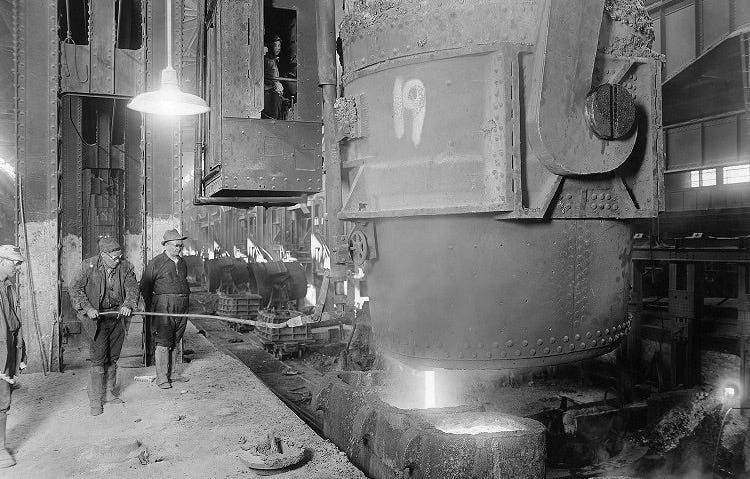
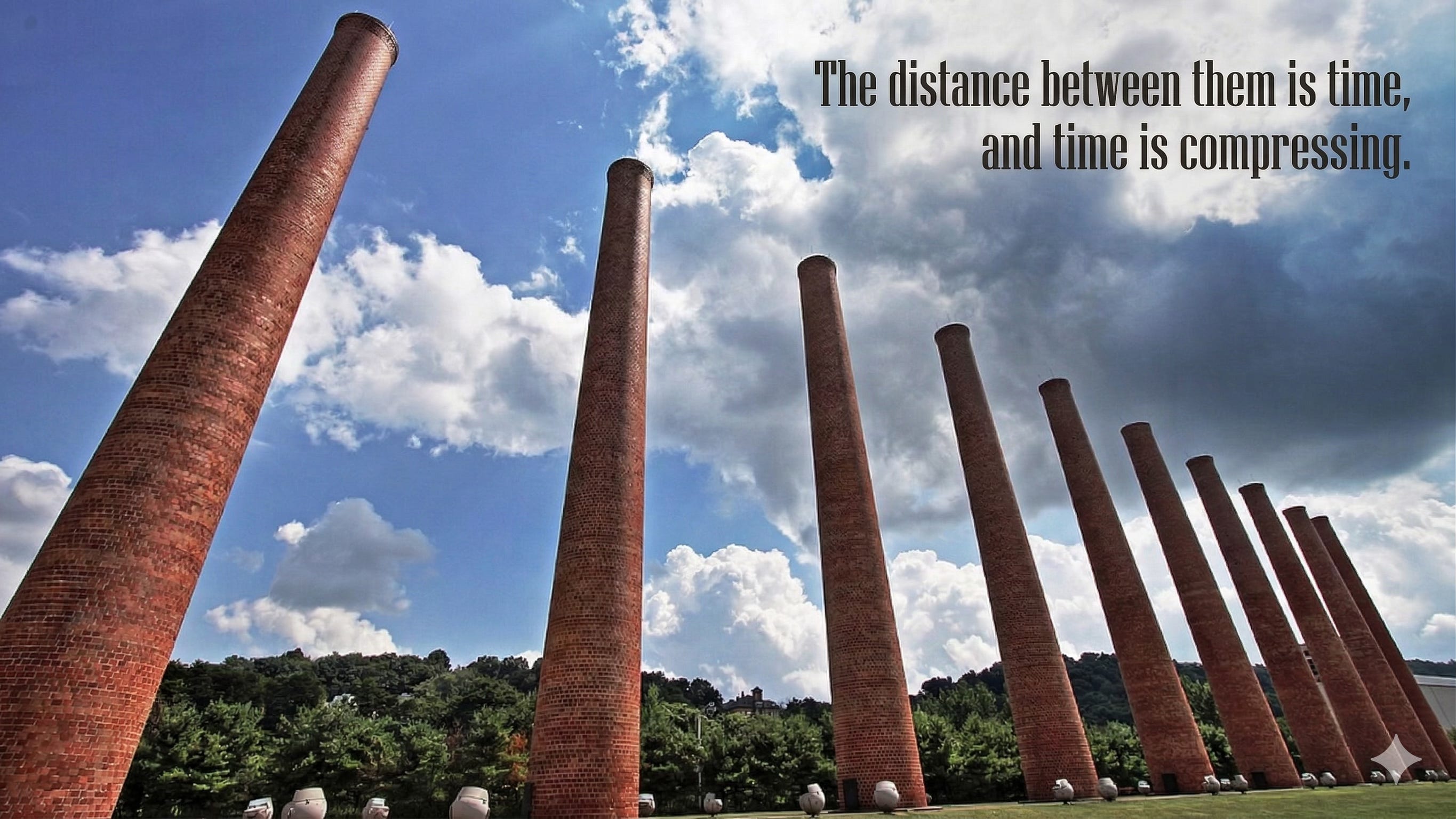
Homestead, Pennsylvania, sits along a bend in the Monongahela River, seven miles southeast of Pittsburgh. The steel mill, which once employed fifteen thousand people1, is a shopping center now. Twelve smokestacks still stand among the retail outlets — the last physical trace of the works that Andrew Carnegie built into the largest steel mill in the world.
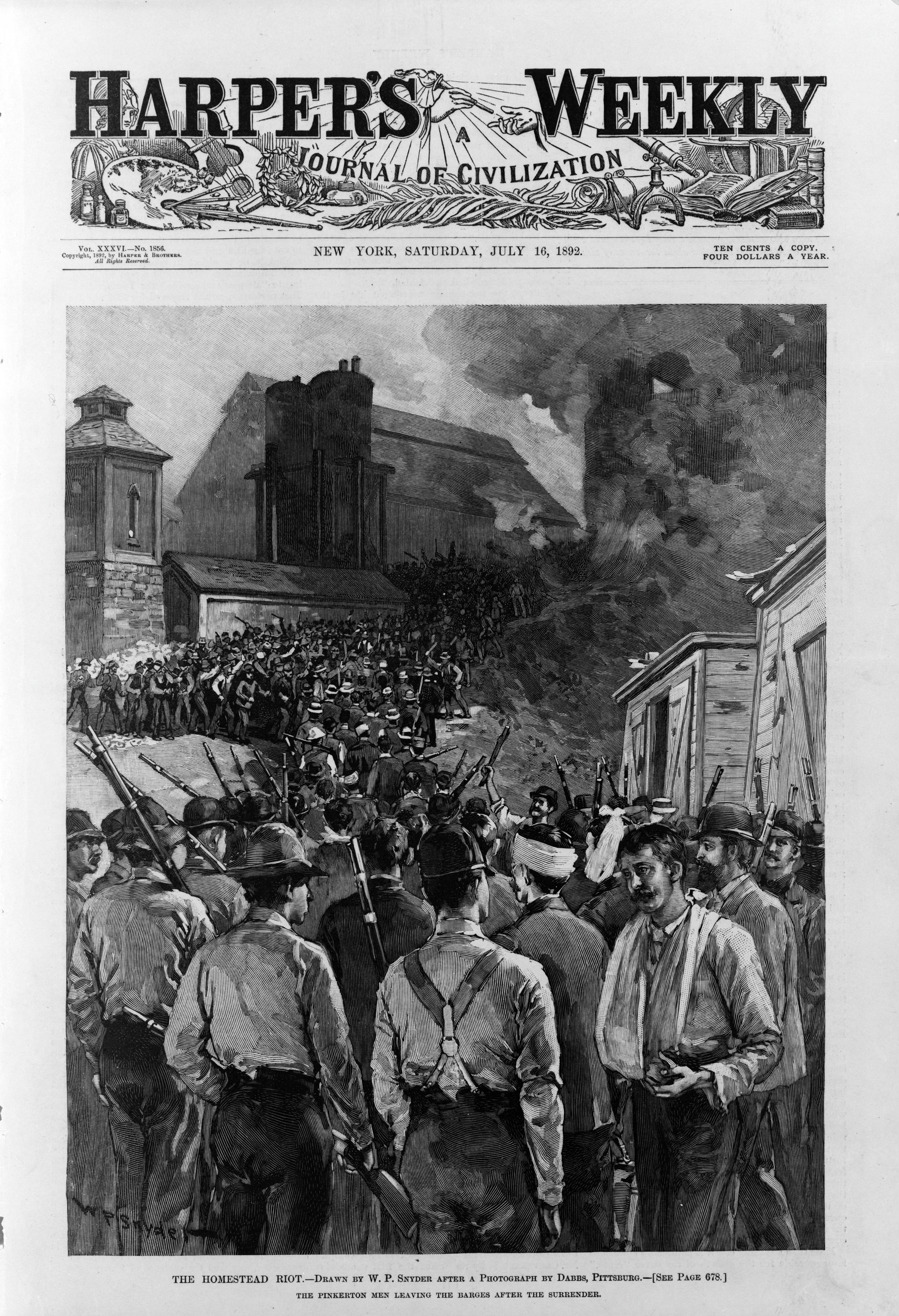
In the summer of 1892, the workers at that mill went on strike. Carnegie’s chairman, Henry Clay Frick, locked them out, ringed the plant with barbed wire and sniper towers, and hired three hundred Pinkerton agents2 to retake it by force. The Pinkertons came up the Monongahela on barges before dawn on July 6th. Thousands of workers and their families met them at the riverbank.
The battle lasted all day. Workers and Pinkertons exchanged rifle fire for hours. The strikers tried cannon fire, burning rafts, dynamite, oil slicks on the river. By evening, the Pinkertons surrendered. At least sixteen people were dead.3 The governor sent more than six thousand state militia to reopen the plant.4 The strike was broken. The union collapsed.
But the fights continued — through the Progressive Era, through the New Deal — until workers won what the men at the riverbank had died for: the right to organize and to share in the prosperity their labor created. By the middle of the twentieth century, steelworkers at Homestead had a union, a pension, health insurance, job security. The deal that people had bled for had, at last, been built.
Margaret Mary Vojtko was born in Homestead in 1930. Her father worked at the mill. He belonged to the union that became the United Steelworkers — the union that carried the legacy of the men who fought on the Monongahela.
She was the youngest of six. Her mother died when she was seven. She grew up speaking Slovak at home, attended a Catholic high school, and worked as a secretary before putting herself through the University of Pittsburgh. She earned a bachelor’s degree, then a master’s. She spoke six languages. She started a doctoral dissertation on the history of Homestead — her father’s workplace, the site of the battle, the place where the deal began.
In 1988, Margaret was hired to teach French at Duquesne University, a Catholic school on a hilltop in Pittsburgh, five miles from where she grew up. She taught there for twenty-five years. She was an adjunct — which meant between $3,000 and $3,500 per course,5 no benefits, no pension, no health insurance, no office, and no guarantee, from one semester to the next, that they would offer her work.
She taught the same courses tenured professors taught, sometimes more. She never missed a day of class. Her student evaluations were glowing. In her best years, teaching three courses a semester plus two in summer, she made under $25,000. Duquesne’s president made nearly $700,000.6
In her final year, the university cut her to one course per semester. She was making well below $10,000. She had cancer and huge medical bills. She couldn’t keep the electricity on in her home. She took a night job at Eat’n Park and tried to sleep during the day in her office at Duquesne. When the university discovered this, they called the police to remove her.
In the spring of 2013, Duquesne let her go. They told her she was no longer effective as an instructor. She was eighty-three years old.
The previous summer, the adjunct faculty at Duquesne had voted to unionize. They organized under the United Steelworkers — the same union Margaret’s father had belonged to, the same union whose roots ran back to the men on the riverbank. Margaret voted yes.
Duquesne refused to recognize the union. The university argued that its Catholic identity exempted it from the National Labor Relations Board. Georgetown, another Catholic university, had just recognized its adjunct union, citing the Church’s social justice teachings to reach the opposite conclusion.7
On August 16th, Daniel Kovalik, an attorney for the United Steelworkers8 who had been helping Margaret file an age discrimination complaint, received a call from her. She was distraught. The cancer was back. She was nearly homeless. And now she had received a letter from Adult Protective Services — someone had referred her case, saying she needed help taking care of herself. For a woman who had taught at a university for a quarter century, who spoke six languages, who had never missed a day of class, the letter was a final indignity.
Kovalik called Adult Protective Services to explain the situation. He told the caseworker that Margaret had just been let go from her job as a professor, that she had received no severance or retirement benefits, that the reason she was struggling was because she was living in extreme poverty. The caseworker paused.
“She was a professor?”
Margaret Mary Vojtko died on September 1, 2013. She was eighty-three. Her funeral Mass was held at Epiphany Church, a few blocks from Duquesne. She was laid out in a cardboard casket with no handles for pallbearers.9
Her father, the steelworker, had had the deal that the men had bled to forge. His daughter did everything the American Dream asked — she got the education, she learned the languages, she climbed from the mill to the university. And she died unable to heat her home, because the system her father’s generation had built was quietly dismantled around her, and nothing had been built to replace it.
Notification
Bernard Moses drove for Uber in the Chicago suburbs for nearly ten years. Twenty thousand rides. A 4.99 average rating. In April 2024, he dropped off a passenger and swiped for the next ride. He was locked out. A customer complaint was all he was told, with no warning, explanation, or appeal. He called support daily for months, working through automated menus, occasionally reaching a voicemail that never called back. His rider account was locked too. Nearly a year later, he had no resolution. But the car payment was still due.10
Jacqueline Bowman left journalism to freelance as a content writer in California. In 2024, something switched. Clients came to her not to write but to clean up what AI had produced — at half her usual rate. It took twice as long. She was spending more hours making half the money, fact-checking fabrications line by line and largely rewriting the article anyway.
“Writing is not going to work out for me any more,” she told The Guardian in February 2026.11 By January 2025 she had lost her health insurance. She brought her wedding forward to get onto her husband’s plan. She is retraining as a therapist.
The Bundle
In most countries, a job is a job. It pays you for your work. Healthcare comes from somewhere else. Retirement comes from somewhere else. Training, labor protections, the safety net when things go wrong— those are handled by other systems, funded in other ways.
In America, we made a different choice. We bundled all of it together and attached it to your employer. Your job was your income, your health insurance, your retirement plan, your access to training, your structure for how your work was managed and evaluated. One relationship carried everything.
This was a design decision, made in stages, mostly during and after World War II, reinforced by tax policy and labor negotiation and decades of institutional habit.12 It worked well enough, for long enough, that we stopped seeing it as a choice at all.
Which meant that when the employment relationship started to change, everything changed with it.
Compensation became unpredictable. A freelancer’s rate depends on how many other freelancers bid this week. A driver’s earnings depend on an algorithm that adjusts in real time, using inputs the driver can’t see, always optimizing from the platform’s margins down to you. The money might be fine this month. There’s no way to know about next month.
Benefits didn’t follow the worker. You can buy health insurance on the exchange, open your own IRA, purchase disability coverage — each of these is possible. Navigating all of them simultaneously, while freelancing across three clients and driving on weekends, requires a level of financial sophistication that the old system never asked of anyone.
Training cycles broke down. There used to be a reasonable bet: learn a skill, practice it, get better, earn more. Companies invested in training because they expected to keep you. That cycle has been speeding up for years. In certain fields, the skill you spent two years learning gets automated before you’ve recouped the investment.
Management became algorithmic. In the old system, your boss was a person. They might be good or bad, fair or unfair, but you could read them, talk to them, appeal to them. Algorithmic management replaces that with a system that makes decisions constantly — about pay, about allocation, about whether you still have a job — and doesn’t explain them. The driver loses control of his rate to an algorithm. The adjunct loses security to enrollment numbers processed by software. And the logic that makes work more efficient doesn’t stop at managing how work gets done. Eventually, it asks whether the human doing the work is needed at all.
Each of these shifts has its own logic. Each system optimizes for its own purposes, with no one watching what happens to the person standing in the middle of all four.
The Investment Thesis
Once the bundle started coming apart, someone was going to figure out how to make money from the pieces.
The first wave was defensive. Legacy industries under competitive pressure discovered they could get the same work done for less by breaking full-time positions into contract roles. A CFO looking at the cost of a full-time employee versus a contractor is responding to real incentives — quarterly earnings, board expectations, competitive pressure. A university president watching state funding decline year after year is making hard choices with shrinking resources. These are rational actors inside a system that rewards exactly this behavior.
“Ideally, you’d have every plant you own on a barge.” — Jack Welch, General Electric13
But the second wave turned those same mechanics into a business model.
Uber doesn’t own cars. Airbnb doesn’t own apartments. DoorDash doesn’t own restaurants or employ delivery drivers. The insight was that you could build a company, quickly, by connecting customers to workers without actually employing anyone or carrying any meaningful assets. The workers brought their own capital — their car, their apartment, their bike — and absorbed their own risk. The platform took a cut of every transaction and retained the one thing that mattered: the customer relationship.
These were talented entrepreneurs solving real problems. Getting a cab in most American cities was a genuinely miserable experience. The platforms removed friction, elegantly. And for a lot of workers, the flexibility was real and valuable.
But the model required something specific: that the people doing the work remain independent contractors. Employees come with the bundle. Independent contractors don’t. Uber and its backers spent over $200 million on California’s Proposition 22 to preserve that distinction.14 The math didn’t work otherwise.
Today, Uber is valued at roughly $145 billion.15 Airbnb at roughly $80 billion.16 DoorDash at roughly $80 billion.17 The combined enterprise value of the major gig platforms runs above $300 billion.18
The average Uber driver, after expenses, makes about $15 an hour.19
Four Hours
Matt Shumer has worked in artificial intelligence for nearly six years. Not as a commentator or a futurist — as a builder. The kind of engineer who understands the technology well enough to know what it can’t do. He’s been skeptical of hype cycles before. He’s watched models improve incrementally and said, correctly, that they weren’t ready yet.
On February 5th, 2026, two major AI labs released new models on the same day. OpenAI launched GPT-5.3 Codex. Anthropic released Claude Opus 4.6.20
Shumer described what happened next on his blog.21 He told the AI what he wanted built, in plain English. He walked away for four hours. When he came back, it was done. Not a rough draft he needed to fix. The finished thing. Tested, refined, ready.
“I am no longer needed,” he wrote, “for the actual technical work of my job.”
This is someone who has spent six years at the frontier of the most consequential technology of the century. His skills are rare. His judgment is hard-won. His compensation reflects that — engineers at this level make $500,000 to $800,000 a year.22 They were supposed to be the last people this happened to.
He described the feeling: “Not like a light switch. More like the moment you realize the water has been rising around you and is now at your chest.”
Then he said the thing that matters:
“The experience that tech workers have had over the past year, of watching AI go from ‘helpful tool’ to ‘does my job better than I do,’ is the experience everyone else is about to have. Law, finance, medicine, accounting, consulting, writing, design, analysis, customer service. Not in ten years. The people building these systems say one to five years.23 Some say less.”
“And given what I’ve seen in just the last couple of months, I think ‘less’ is more likely.”
The driver, the copywriter, even the PhD, each of them could be told — and has been told — that they made the wrong choices. They should have picked a different career. They should have adapted faster. They should have seen it coming.
Matt Shumer made every right choice. He picked the most valuable skill of his generation. He built nearly six years of expertise at the exact frontier of the technology that’s reshaping everything.
And he’s writing blog posts to warn you that it’s already too late for him.
Margaret’s father worked at the mill for forty years before the deal he had was negotiated and secured. Margaret taught for twenty-five years before her deal was taken away. Matt Shumer worked at the frontier for six years. Four hours was enough to see the end.
Cardboard
The distance between Matt Shumer and Margaret isn’t merit. It’s time.
Her father had the deal. He’d had it because men before him had fought for it.
His daughter had a cardboard casket with no handles.
The system her father’s generation built was quietly dismantled around her, and nothing was built to replace it. The driver, the copywriter, the PhD, the elite engineer — they’re all standing somewhere on the same arc Margaret traveled. The distance between them is time, and time is compressing.
The question isn’t whether the system will break. It broke a long time ago. The caseworker who paused on the phone and said “She was a professor?” — she already knew.
The question is what we build next.
Suggested Sources
American Labor History
Paul Kahan, The Homestead Strike: Labor, Violence, and American Industry (Rowman & Littlefield, 2014)
Les Standiford, Meet You in Hell: Andrew Carnegie, Henry Clay Frick, and the Bitter Partnership That Changed America (Crown, 2005)
David Brody, Steelworkers in America: The Nonunion Era (Harper Torchbooks, 1960)
The Employer Bundle / Benefits History
Jacob Hacker, The Divided Welfare State: The Battle over Public and Private Social Benefits in the United States (Cambridge University Press, 2002)
Jennifer Klein, For All These Rights: Business, Labor, and the Shaping of America’s Public-Private Welfare State (Princeton University Press, 2003)
Gig Economy / Platform Labor
Alex Rosenblat, Uberland: How Algorithms Are Rewriting the Rules of Work (University of California Press, 2018)
Lawrence Mishel, “Uber and the Labor Market,” Economic Policy Institute (2018)
Adjunct Labor
American Association of University Professors (AAUP), annual “Contingent Faculty” data reports
AI and Labor Displacement
Dario Amodei, “Machines of Loving Grace” (Anthropic blog, 2024)
Daron Acemoglu and Pascual Restrepo, “Robots and Jobs: Evidence from US Labor Markets,” Journal of Political Economy 128:6 (2020)
Financialization of American Industry
Rana Foroohar, Makers and Takers: The Rise of Finance and the Fall of American Business (Crown Business, 2016)
Barry Lynn, End of the Line: The Rise and Coming Fall of the Global Corporation (Doubleday, 2005)
The Homestead Works was the largest steel mill in the world at its peak. It opened in 1881 and closed in 1986. Wikipedia’s “Homestead, Pennsylvania” article records approximately 7,000 employed in the plants circa 1900; the plant expanded significantly during WWII for armor plating production. No single publicly accessible source confirms a specific peak employment figure. “Tens of thousands” reflects the documented scale of the facility across secondary accounts.
Wikipedia, “Homestead Strike,” citing multiple historians. The Pinkerton Agency dispatched 300 agents, who traveled by barge up the Monongahela River. This figure is consistent across primary and secondary sources.
Casualty counts vary by source. The Pennsylvania historical marker records seven workers and three Pinkertons killed — ten total confirmed deaths. Some historians, including Paul Kahan (The Homestead Strike: Labor, Violence, and American Industry, 2014) and Philip Taft and Philip Ross (”American Labor Violence,” 1969), cite higher totals — including nine workers and seven Pinkertons for sixteen — when counting deaths from injuries that occurred in the days following the battle. “At least sixteen” reflects the higher-end but documented range.
Wikipedia, “Homestead Strike,” citing Krause, The Battle for Homestead (1992), pp. 337-338. Pennsylvania Governor Robert Pattison ordered the mobilization on July 10, 1892; troops arrived July 12. Total militia mobilized over the full occupation is estimated at 8,000-8,500.
Daniel Kovalik, “Death of an Adjunct,” Pittsburgh Post-Gazette, September 18, 2013. Kovalik gives the range as “between $3,000 and just over $3,500 per three-credit course.”
Kovalik, ibid. Kovalik writes: “Compare this with the salary of Duquesne’s president, who makes more than $700,000 with full benefits.” The most publicly documented figure in Duquesne’s IRS Form 990 filings is $678,893 (2011); the Duquesne Duke reported in April 2014 that pay was “nearing $700,000.” The essay uses “nearly $700,000” to reflect the documented range.
Georgetown University adjunct faculty voted to unionize under SEIU Local 500 in May 2013. Georgetown’s administration recognized the union, with university leadership citing papal encyclicals including Rerum Novarum and Caritas in Veritate as grounding for its decision. See: Inside Higher Ed, “A Union Vote at Georgetown,” May 2013; SEIU Local 500 press releases, May 2013.
Kovalik’s full title: Senior Associate General Counsel of the United Steelworkers union. Full citation: Daniel Kovalik, “Death of an Adjunct,” Pittsburgh Post-Gazette, September 18, 2013. Archived.
Kovalik, “Death of an Adjunct”: “simple, cardboard casket devoid of any handles for pallbearers.” All details in this section are drawn from Kovalik’s firsthand account.
Joe Wilkins, “Uber Drivers Say They’re Getting Locked Out of the App and Trapped in a Kafkaesque Limbo When They Try to Dispute It,” Futurism, March 19, 2025. -- The article reports on the Action Center on Race and the Economy (ACRE) report “Driven Out By AI,” which surveyed 727 deactivated rideshare drivers. ACRE report.
Lucy Knight and Sumaiya Motara, “The big AI job swap: why white-collar workers are ditching their careers,” The Guardian, February 11, 2026.
In 1942, the National War Labor Board restricted direct wage increases under the “Little Steel formula” but allowed employers to offer non-wage benefits, creating the financial incentive for companies to offer health insurance and pensions to attract workers during tight wartime labor markets. The tax exclusion for employer-provided health benefits was codified in the Internal Revenue Code (1954), cementing the bundle into the structure of American employment. See: Jacob Hacker, The Divided Welfare State (Cambridge University Press, 2002); Jennifer Klein, For All These Rights (Princeton University Press, 2003).
Widely attributed to Jack Welch, CEO of General Electric, c. early 1990s, as encapsulating GE’s approach to labor arbitrage and offshoring during his tenure (1981-2001). The exact wording varies across secondary sources; no confirmed primary source (interview transcript, speech recording, or contemporaneous print attribution) has been identified. The sentiment is consistent with documented GE strategy and Welch’s public statements of the period. See: Konzelmann and Forrant, “Governance, Labour and Resource Management,” Industrial Relations Journal 35:4 (2004); Louis Uchitelle, The Disposable American: Layoffs and Their Consequences (Knopf, 2006).
Wikipedia, “2020 California Proposition 22”: “Lyft, Uber, DoorDash, Instacart, and Postmates contributed over $205 million into campaigns supporting Prop 22.” At the time of the vote, it was the most expensive ballot measure in California history. Uber was the largest single contributor; Lyft contributed a near-equal amount.
Market capitalization per CompaniesMarketCap.com, accessed February 2026. Uber Technologies, Inc. (NYSE: UBER). Market caps fluctuate; figures reflect early-2026 valuations.
Market capitalization per CompaniesMarketCap.com, accessed March 2026. Airbnb, Inc. (NASDAQ: ABNB). Updated from February 2026 figure of ~$75B to reflect current ~$80B valuation.
Market capitalization per CompaniesMarketCap.com, accessed March 2026. DoorDash, Inc. (NYSE: DASH). Updated from February 2026 figure of ~$70B to reflect current ~$80B valuation.
Combined market capitalizations of Uber, Airbnb, and DoorDash as of March 2026. Market caps fluctuate; the combined figure has moved from approximately $290B (February 2026) to above $300B.
California Legislative Analyst’s Office, analysis of 2020 California Proposition 22 (October 2020): “Most drivers probably make between $11 and $16 per hour after accounting for vehicle expenses.” The essay’s “$15” falls within this range. Estimates vary by market and study; the LAO analysis is the most cited public figure, though it dates from 2020. See also: Lawrence Mishel, “Uber and the Labor Market,” Economic Policy Institute, May 2018.
Both releases confirmed. GPT-5.3 Codex (OpenAI) and Claude Opus 4.6 (Anthropic) launched on February 5, 2026. Covered in Shumer’s account (footnote 20) and confirmed by contemporaneous tech reporting
Matt Shumer, “Something Big Is Happening,” shumer.dev, February 9, 2026. -- All block quotes in this section are drawn from this article. Also cross-posted to LinkedIn. Shumer is the founder and CEO of HyperWrite (formerly OthersideAI) and a seed investor in early-stage AI startups.
Total compensation (base salary + equity + annual bonus) for senior and staff engineers at leading AI companies, per Levels.fyi and industry reporting. Base salary alone is typically $200,000-$350,000; equity and bonus bring total compensation into the $500,000-$800,000+ range at Anthropic, OpenAI, Google DeepMind, and Meta AI.
Shumer, ibid. The article also cites Dario Amodei, CEO of Anthropic: “He says we may be ‘only 1-2 years away from a point where the current generation of AI autonomously builds the next.’” The Amodei source is his January 2026 essay “The Adolescence of Technology,” published on the Anthropic blog.
yes, time really is compressing. Did you know that in the UK we weren't really taught about company towns? (we had some good ones like bourneville here, not the horror stories in the US). I only learnt about it in the last year when I read Parable of the Sower.