
“A decent home and a suitable living environment for every American family.”
— The United States Housing Act of 1949, Declaration of National Housing Policy
A Home He Built by Hand
Don Lund moved into Golfview Mobile Home Court in North Liberty, Iowa, in 1980. He planted pine and peonies and hostas and lilacs, built a front deck and a back deck with his father, and became president of the residents’ association. Don was a quadruple congenital amputee. He worked as a sports writer covering Iowa Hawkeye athletics, lived on food stamps and Social Security, and budgeted with the precision that poverty demands.
In 2019, Havenpark Communities, an Utah-based investment firm, purchased Golfview. Don’s lot rent was $87 a month. He came home to a notice on his door: rent jumping to $450, then to $506. Following public outcry, the increases were spread over approximately two years. His income hadn’t changed. His home hadn’t changed. Only the ownership of the ground beneath him had changed—and with it, every assumption his life was built on.
“Just because I don’t have a lot of money,” Don told reporters, “doesn’t mean I’m not important.”1
Don Lund died in April 2023.2
The Promise
After World War II, the federal government actively promoted manufactured housing as a path to middle-class stability. Returning veterans needed homes fast, and the construction industry couldn’t build conventional housing quickly enough. Factory-built homes—first called “trailers,” then “mobile homes,” eventually “manufactured housing”—offered a solution: decent shelter at a fraction of the cost, producible at industrial scale.
The industry boomed. By the 1960s, manufactured homes accounted for a significant share of new single-family housing. In 1974, Congress passed the National Mobile Home Construction and Safety Standards Act, which for the first time established federal building codes for factory-built homes—administered by HUD, making manufactured housing the only form of housing in America regulated at the federal rather than local level. The HUD Code, updated in 1994 and periodically since, was designed to ensure quality and build consumer confidence. It was a statement of legitimacy: this is real housing, backed by the federal government, suitable for American families.
The deal was this: You can own a home. It will cost less than a conventional house. It will be built to federal standards. You will have stability, equity, and a step into the middle class. This is how ordinary Americans build a life.
Twenty-two million Americans accepted that deal. Manufactured housing remains the largest source of unsubsidized affordable housing in the country—roughly 6% of the population, 10% of new housing stock.3
Personal Property
Despite the name, mobile homes are not mobile. Moving one costs between five and twelve thousand dollars—often more for a double-wide—and frequently damages or destroys the structure.4 Over 90% never move once placed. Annual turnover averages roughly 10%, about a third the rate in apartment buildings. Investors call this “stability,” but the more honest word has become captivity.
A resident owns the home—a depreciating asset, often financed as personal property, like a car, at higher interest rates and shorter terms, rather than through a conventional mortgage. She rents the land—an appreciating asset she does not control, under terms that can change without her consent. When lot rent rises, there is no comparable alternative. When services decline, there is no leverage. The home that promised stability becomes a mechanism of exposure for families working hard to climb into the middle class.
The Notice in the Mailbox
Linda Bates used a disability settlement—the largest sum she had ever received—to buy a mobile home for $62,000 in 2016. She moved with her daughter and granddaughter to Midwest Country Estates in Waukee, Iowa. It was the safest investment she could imagine.
Three years later, Havenpark Capital acquired the park as well. New rules. New fees. Then notice that her lease would not be renewed. There was no reason given. In Iowa, this is called a “no fault” eviction, and it is legal.5
Linda owned her home. She did not own the land. She had to leave or be removed by the sheriff.
Moving the structure was financially impossible. She found a buyer willing to pay $22,500—less than half what she had paid three years earlier. At sixty-three, disabled, she left behind the only major asset she had ever owned.6
Land. Finance. Tenure. Ownership.
What makes manufactured housing incoherent is the collision of four systems, each following its own logic and none accountable for what happens to the person standing at the intersection.
*Land.* Zoning laws passed decades ago to exclude mobile home parks from suburban neighborhoods effectively banned new parks from being built. The intent was exclusionary. The long-term consequence was monopoly. If you own one of a handful of legally permitted parks in a metro area, you have a captive market that can never be diluted by new supply. The zoning meant to protect property values for the owners of single-family homes created the preconditions for extraction from the owners of mobile homes.
*Finance.* Manufactured homes are typically excluded from conventional mortgage products. Chattel loans carry interest rates 2-5% higher than standard mortgages, with terms of fifteen to twenty years instead of thirty.7 The monthly cost is driven more by debt structure than by the home’s value.
*Tenure.* In many states, lease terms run a year or less—against lives measured in decades. Don Lund lived at Golfview for forty-two years. His legal right to stay was renewed twelve months at a time. Protections vary widely by state, and enforcement is uneven where protections exist. Decades of residency, of building decks and planting gardens, confer almost no security when the land changes hands.
*Ownership.* You hold title to the home. But it sits on someone else’s land, depreciates from the day you buy it, and its resale value is mathematically tethered to the rent beneath it. The relationship is roughly linear: by one common analytical estimate, every $100 increase in monthly lot rent destroys approximately $10,000 in resale value.8 The resident doesn’t just lose cash flow. She loses net worth. Linda’s home didn’t depreciate because it deteriorated. It depreciated because someone raised the rent.
The resident must navigate all four systems simultaneously. No actor is accountable for the combined result.
When the Investment Thesis Arrives
Over the past decade, institutional investors have purchased roughly one-fifth of manufactured home parks in the United States.9
The thesis is straightforward: a fragmented industry of aging park owners represents a consolidation opportunity. Buy at low multiples, raise rents toward “market” rates, reduce operating costs, hold the asset until the right moment to flip. In private equity-backed parks, the majority of returns come from rent and fee increases rather than from adding units or improving services.
The target is 5-8% annual rent increases—two to four times general inflation. Compounded over a typical seven-year hold, that means cumulative increases of roughly 40-70%.10
Nearly half of these acquisitions are financed through Fannie Mae or Freddie Mac11 —government-sponsored enterprises created to expand access to affordable housing. The federal government, through its lending apparatus, subsidizes the purchase of the affordable housing it aims to promote.
“One of the big drivers to making money is the ability to increase the rent. If we didn’t have them hostage, if they weren’t stuck in those homes in the mobile home lots, it would be a whole different picture.” — Frank Rolfe, Mobile Home Park Investing Home Study Course
The portfolio manager allocating capital to manufactured housing is not sitting in a room plotting to ruin Don Lund’s life. She is evaluating risk-adjusted returns across asset classes, under fiduciary obligations to her investors—pension funds, university endowments, retirement accounts. The parks she’s buying were often under-maintained by their previous owners, and the rents were often genuinely below what the local market could bear. From inside her spreadsheet, the logic is clean. She may even believe, with some justification, that professional management will improve conditions in the long run.
Stability
Nicole Platz moved to Modern Manor in Iowa City in 2009. Lot rent was $395. The park included trash service, yard care, and responsive management.
When Havenpark took over in 2019, her rent increased nearly 40%. Services disappeared. In January 2025, the park lost running water for three days. Residents used plastic bags as makeshift toilets.12
Havenpark had already done this at Golfview and Midwest Country Estates. The firm had a playbook. The residents had a notice on their door.
The consequences extend beyond housing economics. People who live in the same place for more than five years vote at significantly higher rates than those who’ve moved in the past year. They volunteer more, join civic organizations, serve on school boards, know their city council members by name. Community tenure is among the strongest predictors of local political participation, reinforcing the effects of education and income, and sometimes substituting for them.13 When housing becomes unstable, the institutions that require sustained local engagement begin to hollow out. A 2023 study found that each one-percentage-point increase in neighborhood eviction rates was associated with a nearly half-point decline in voter turnout.14
Sixteen Million Units
Don Lund lived in a “mobile” home.
When you rent an apartment, mobility is an explicit part of the bargain. But even that bargain is becoming subtly incoherent.
In conventional rental markets, large landlords increasingly use pricing software—most notably RealPage’s YieldStar platform—to determine what tenants pay. Individual landlords feed their occupancy data, lease terms, and pricing into RealPage’s system. The algorithm aggregates this nonpublic data across competing properties in the same market—properties whose owners would violate antitrust law if they shared pricing information directly—and generates rent recommendations calibrated to maximize collective revenue. The software has explicitly recommended that landlords accept higher vacancy rates in exchange for higher per-unit revenue, overriding the competitive logic that is supposed to push rents down when apartments sit empty. A 2022 investigation found that RealPage’s clients managed more than sixteen million units nationwide.15 In some markets, a single algorithm effectively set the price for the majority of available apartments.
In August 2024, the Department of Justice filed an antitrust suit against RealPage, alleging that the platform enabled landlords to coordinate pricing in violation of the Sherman Act.16 The complaint describes a system designed to replace competitive pricing with algorithmic consensus—a cartel mediated by code rather than a handshake.
Amanda Tolep rented in Seattle’s Belltown neighborhood, in a building managed by Essex Property Trust—one of ten landlords that together controlled 70% of the 9,000 apartments in her area. Every one ran YieldStar. When her rent jumped 33% in a single year, she looked for alternatives in her area. There were none. The algorithm was running everywhere she could go. She left the city and started over in a community thirty miles north.
In Boston, Kaylee Hutchinson tried to negotiate with her landlord during the first pandemic lockdown, when vacancies were rising and market logic said prices should fall. The landlord held firm. “It was pretty obvious they should have been dropping prices,” she said. “These companies, they’ll just replace you.”17
The same algorithmic repricing logic is now appearing in homeowner insurance markets, where carriers have exited or sharply raised premiums across California, Florida, and Texas—removing a layer of stability from conventional homeownership that most owners assumed was permanent.[^20]
Forty Years
Don Lund planted lilacs. He built decks with his father. He did everything the system asked of him, for near forty years, in a home he believed was his.
The rules didn’t protect him.
Suggested Sources
The History and Structure of Manufactured Housing
Esther Sullivan, *Manufactured Insecurity: Mobile Home Parks and Americans’ Tenuous Right to Place* (University of California Press, 2018) — the foundational academic account of park life, tenant organizing, and displacement
Zoning, Supply, and Land Use
Terner Center for Housing Innovation, “Regulation and Housing Supply” (2023)
National Zoning Atlas project — state-by-state data on manufactured housing restrictions in zoning codes
Algorithmic Pricing and Rental Markets
Herbert Hovenkamp and Fiona Scott Morton, “Framing the Chicago School of Antitrust Analysis,” *University of Pennsylvania Law Review* (2020) — legal theory underlying the DOJ RealPage case
Macroeconomic Context
Bolhuis, Cramer, and Summers, "Comparing Past and Present Inflation," NBER Working Paper No. 30116 (2022); published in Review of Finance Vol. 26 — on CPI shelter cost methodology
Fonseca and Liu, “Mortgage Lock-In, Mobility, and Labor Reallocation,” Federal Reserve Bank of New York Staff Reports (2023) — on how locked-in homeowners suppress conventional housing supply
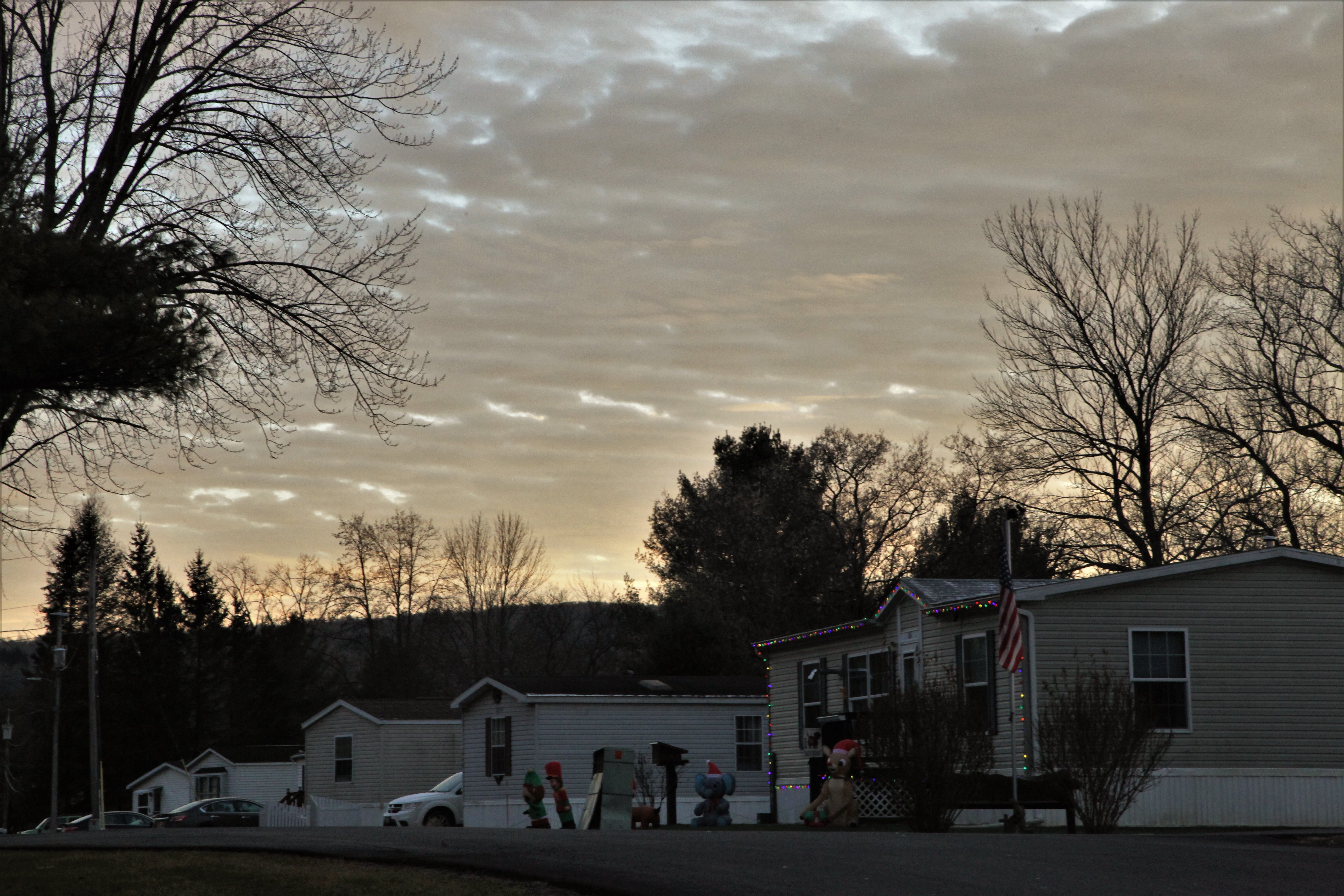
Note: the first photo is of Creekside Mobile Home Park, Esperance, New York. Photo: Famartin / Wikimedia Commons, CC BY-SA 4.0
Quoted in Elijah Helton, “Residents of North Liberty Mobile Home Park Say They Can’t Afford Rent Hikes,” *Iowa City Press-Citizen*, June 20, 2019.
Don Lund’s story is drawn from reporting by the *Iowa City Press-Citizen* and *Little Village Magazine* (2019–2023). Rent figures and timeline confirmed through Golfview Residents Association records and Havenpark Communities public filings.
Manufactured Housing Institute, “Quick Facts” (2024); U.S. Census Bureau, American Community Survey data on housing units by structure type.
Esther Sullivan, *Manufactured Insecurity: Mobile Home Parks and Americans’ Tenuous Right to Place* (University of California Press, 2018). Relocation cost estimates from the Manufactured Housing Institute and consumer surveys.
Iowa Code § 562B.10 governs lease terms and cancellation in manufactured home communities. The section requires 90 days' written notice and prohibits termination "solely for the purpose of making the tenant's mobile home space available for another mobile home" — but does not restrict termination for other non-fault reasons such as park redevelopment. The result is that residents face significant exposure to displacement with limited legal recourse.
Linda Bates’s account is drawn from reporting by the *Des Moines Register* and the Iowa Policy Project. Quotes confirmed through published interviews, 2019–2020.
Consumer Financial Protection Bureau, “Manufactured Housing Finance: New Insights from the Home Mortgage Disclosure Act Data” (2023). On CPI treatment of interest costs: Bureau of Labor Statistics, “How the CPI Measures Shelter Costs.”
The resale value relationship is described in Terner Center for Housing Innovation, “Private Equity in Manufactured Housing” (2024), and consistent with capitalization rate analysis of income-dependent assets. The approximate $10,000/$100 figure is an analytical estimate based on standard cap rate assumptions, not a precise empirical finding.
Terner Center for Housing Innovation, “Private Equity in Manufactured Housing” (2024); *Financial Times*, “Private Equity’s Bet on Mobile Home Parks” (2023).
Rent increase targets in PE-backed manufactured housing parks are documented in investor fund materials and investigative journalism. The Private Equity Stakeholder Project's tracker of manufactured housing acquisitions notes lot rent increases of 40–100% or more at PE-owned parks over holding periods of 5–10 years. See: Private Equity Stakeholder Project, "Investors in Affordable Housing" (updated annually); Sharon Lerner and Maureen Tkacik, "Families in Mobile Home Parks are Being Priced Out by Wall Street," The Intercept, October 19, 2021.
Fannie Mae and Freddie Mac manufactured housing community lending data is published in their annual Duty to Serve reports. On the tension between GSE affordable housing mandates and investor acquisition financing: National Housing Law Project, “Federally Financed Displacement” (2023).
Nicole Platz and Modern Manor conditions reported by *Iowa City Press-Citizen* and KCRG-TV9, 2019–2025.
Robert D. Putnam, Bowling Alone: The Collapse and Revival of American Community (Simon & Schuster, 2000), pp. 204–205; Benjamin Highton and Raymond E. Wolfinger, “Estimating the Effects of the National Voter Registration Act of 1993,” Political Behavior 20:2 (1998), pp. 79–104. On residential stability and civic participation more broadly, see also Highton, “Residential Mobility, Community Mobility, and Electoral Participation,” Political Behavior 22:2 (2000), pp. 109–120.
Gillian Slee and Matthew Desmond, “Eviction and Voter Turnout: The Political Consequences of Housing Instability,” *Politics & Society*, Vol. 51, No. 1 (2023), pp. 3–29. DOI: 10.1177/00323292211050716.
Heather Vogell, “Rent Going Up? One Company’s Algorithm Could Be Why,” *ProPublica*, October 15, 2022. The sixteen million unit figure is from RealPage’s own marketing materials as reported by ProPublica. On the mechanics of algorithmic price coordination: Hovenkamp and Scott Morton, “Framing the Chicago School of Antitrust Analysis,” *University of Pennsylvania Law Review* (2020).
*United States v. RealPage, Inc.*, No. 1:24-cv-00710 (M.D.N.C., filed Aug. 23, 2024). DOJ complaint available at justice.gov.
On insurance market disruption: *New York Times*, “The Insurance Crisis Is Reshaping the Housing Market” (2024); Florida Office of Insurance Regulation, annual market reports; Congressional Research Service, “Climate Change and Insurance” (2024).
Heartbreaking. And infuriating.