
American Dreaming explores why effort no longer seems to translate into stability and opportunity for a growing number of people. From time to time, we'll pause to get our bearings before moving forward.
This essay is the second in a four-part series meant to frame the conversation we'll be having here. The Age of Incoherence began by naming the unease itself — the sense that something fundamental has shifted, even if it's hard to say exactly how.
This essay explores why.

On November 12, 1942, a ship slid down the ways at Kaiser’s Richmond shipyard in California and into the San Francisco Bay. The Robert E. Peary had been built in four days, fifteen hours, and twenty-nine minutes — a record that still stands.1 It was the fastest a ship had ever been built in human history, and it was built by workers who, eighteen months earlier, had never built a ship at all.
Henry Kaiser had no shipbuilding experience. Neither did most of his workforce. They were welders, riveters, pipe fitters pulled from farms and factories across the country, many of them women, many of them Black workers who’d been barred from the industry before the war made discrimination an unaffordable luxury. Kaiser didn’t retrain them as traditional shipbuilders. He broke the process into components, standardized the parts, and ran three shifts around the clock.
By the end of the war, American shipyards had produced 2,700 Liberty Ships. They carried the materiel that kept Britain alive, supplied the Soviet Union, and landed the armies that ended the war. The America that built them was producing more than half the world’s industrial output.2 It had emerged from the Depression with an industrial base so vast and flexible that it could retool for anything — make bombers in automobile plants, turn civilian welders into the builders of the largest merchant fleet in history.
By 1944, they were launching a ship every day at the Richmond yards. The workers went home at night past the hulls of the ones still being built. They had done something no one had thought possible.
Today, 82 years later, that capacity is gone.
The Silence in Austin
The texts started Monday night. “Power out.” “Rolling outages.” But by Tuesday, the messages didn’t line up. Someone was dark for twelve hours. Someone else never lost power. The map had no logic. Just the ongoing fact of cold and the thin instruction to stay safe.
Marleny Almendarez lived in Pleasant Grove, a neighborhood in Dallas where the houses run old and the insulation runs thin. She was a single mother, 38 years old. Eight people shared the house across three generations. Her power went out Monday night. By the time she and the kids woke the next morning, the silence was heavy. The kind where the refrigerator hum is gone.
When the kids woke up that morning, they found the parakeet frozen to death inside the house.
By the second night, she had decided she wasn’t going to sleep under 38 degrees again. She gathered the children and planned to spend the night in her 2001 Toyota Corolla. Someone from the city called before it came to that — there was a charter bus being used as a warming station. They went.
When she came back, the house was colder than when she’d left. “It has been infinite sadness,” she told reporters. “You feel helpless, not being able to do anything.”
Across town, Tanya Debose was doing something methodical. She ran a redevelopment council in Independence Heights, a historically Black neighborhood in Houston. During the storm, she started surveying neighbors over social media, asking who had power and who didn’t. The pattern that emerged was not random. Her Black and brown neighbors were, she said, “almost all still in the dark.”3
The grid’s emergency protocols directed power to circuits serving hospitals and critical infrastructure. Those facilities weren’t evenly distributed. The neighborhoods with the most resources to weather a storm also happened to be on the circuits that stayed lit. Independence Heights went dark.4
787
Buffer is the slack in a system that lets it absorb a bad day without becoming a crisis — the spare plane, the extra driver, the second supplier, the substitute teacher, the second shift at the munitions plant. Buffer is what sits idle most of the time and looks, on any spreadsheet, like waste.
A resilient system has buffer. It bends under pressure and returns. A bad day stays a bad day.
A brittle system doesn’t. It holds under normal conditions — it may even look robust — but has no give. When pressure arrives, it snaps. The failure isn’t gradual. It holds until it doesn’t.
Brittle systems make randomness catastrophic. When there’s no buffer to absorb a storm, a storm doesn’t stay a storm — it cascades. The flight cancels, and then the next one cancels, because there’s no spare aircraft anywhere in the network. The power doesn’t flicker. It goes out for five days, because the grid was running at capacity and there was nothing left to give.
The logic behind all of this isn’t an accident. It is the logic of efficiency. For decades, efficiency has been the organizing principle of American industry. Anything that looked like slack was waste. Redundancy was costly.
In the late 1980s, Boeing was one of the most vertically integrated manufacturers in the world. It made enormous quantities of its own parts. It kept large inventories. It had buffer. Then it looked at Toyota and saw a different way: just-in-time, lean production, suppliers delivering components exactly when needed, no stockpiles sitting idle, capital freed up from inventory.
The first full experiment was the 787 Dreamliner, launched in 2004. Boeing distributed manufacturing across fifty tier-one suppliers in dozens of countries. Wings from Japan. Fuselage sections from Italy and South Carolina. Composite materials from Korea. Each supplier would deliver finished sections that Boeing would simply assemble.
The supply chain was elegant on paper. In practice it was a catastrophe. Integration failures cascaded. Sections arrived that didn’t fit together. Engineers who no longer understood the full chain couldn’t diagnose the problems fast enough. The 787 was three years late and billions over budget. While Boeing worked through three years of integration failures, Airbus had time to redesign its competing aircraft from scratch. The A350 that entered service in 2015 was competitive in a market Boeing should otherwise have owned.5
Boeing doubled down. By the time the 737 MAX entered service in 2017, the supply chain logic had been applied everywhere — including to the software. Boeing had outsourced significant software development for the MAX to firms like HCL Technologies in India, at a fraction of what Boeing’s own engineers would have cost. Each piece was optimized. Boeing was responsible for the whole — but the supply chain’s complexity had become the brittleness. Responsibility existed on paper. The system made it impossible to exercise.6
Two 737 MAXes fell out of the sky — 346 people dead, both within five months of each other. MCAS ran on a single sensor with no backup. Boeing had distributed the work so completely that no one held the whole system in their head anymore.
Then, on January 5, 2024, a door plug blew out of an Alaska Airlines 737 MAX 9 at 14,800 feet. A child had been sitting in the adjacent seat minutes before departure. Four bolts that should have secured the plug were missing — removed during maintenance and never replaced.7
The investigation found not a rogue mechanic but a system — documentation gaps, quality control gaps, a workforce that had been reduced and reorganized, oversight that had been optimized alongside everything else.
No one held the whole system in their head any longer.
Derailed
Harry Shaffer was asleep on the couch in Hyndman, Pennsylvania when the train hit his house at 4 a.m. on August 2, 2017. His wife had woken him — did he hear that metallic screeching from up the valley? She opened the door. A moment later came a thunderous crack of splintering lumber and debris shot through the living room. Shaffer opened his eyes to find a hulking train car steps from where he lay. It had sheared off the roof, exposing the pre-dawn sky.
He ran outside. Mounds of what looked like grain had spilled from the cars. Molten sulfur crawled across the grass like lava. His neighbor Kristina Sutphin was screaming from a second-floor window — a train car had struck her house too, knocking a wall panel studded with nails across the stairs, trapping her and her two-year-old daughter. Shaffer ran for a ladder.
Volunteer firefighters raced door to door. The tanker car at the center of the blaze contained propane. If it erupted and set off the six surrounding it, the explosion could have taken the entire town.
Three days later, Shaffer learned that his German shepherd, Diamond, had been crushed to death in his bedroom. The bedroom where, on any other night, he and his wife would have been sleeping.
The train was two miles long, 18,252 tons, hauling hazardous materials, with brake problems flagged at the previous stop. It had been assembled in Chicago and lengthened in Ohio and lengthened again in Pennsylvania. The engineer who boarded it in Connellsville described it as “big and heavy and ugly.” He took it anyway. The system required him to.
The doctrine had a name. Precision Scheduled Railroading — PSR — was designed to drive down operating ratios: expenses as a percentage of revenue. The tools were the same ones Boeing had used: strip the redundancy, distribute the work, optimize each piece, trust the system to hold. Fewer workers per train. Fewer inspections. Fewer stops.
Trains lengthened yard by yard because longer trains meant fewer trains, and fewer trains meant a better number on the spreadsheet. The Class I railroads cut 30% of their freight workforce in four years. Wayside detectors were tuned to minimize false alarms — which also meant they were tuned to allow more real ones through.
In March 2021, Vice ran a piece quoting railroad workers watching all of this happen in real time. The headline: “It’s Going to End Up Like Boeing.”
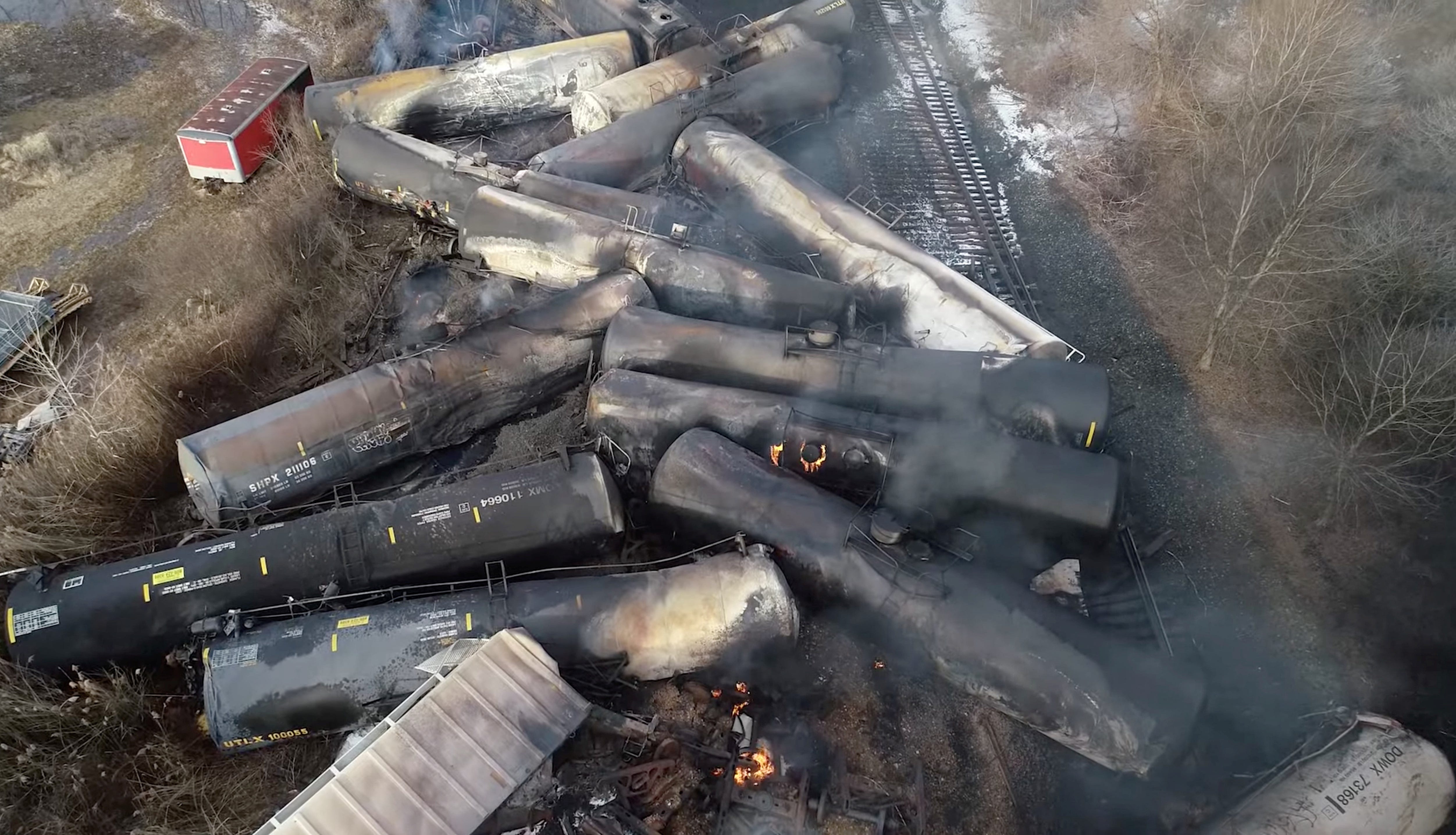
February 3, 2023. A Norfolk Southern train passed the detectors outside East Palestine, Ohio. The sensors flagged a wheel bearing. The threshold for emergency braking wasn’t triggered. Thirty-eight cars derailed. Eleven tank cars released 100,000 gallons of vinyl chloride, benzene, and butyl acrylate. Emergency crews conducted a controlled burn to prevent a worse explosion.
The smoke released phosgene — used as a chemical weapon in the First World War — into the air over a town of five thousand people. About 1,500 residents evacuated. They came back to water they couldn’t drink and explanations that kept changing.
Five and a half years. Three hundred miles. The same decision.8
June Tired
Carrie Tulbert is the principal at Oakwood Middle School in Statesville, North Carolina. In the fall of 2021, she was driving school buses herself — twice a week, two days a week — because the district couldn’t find enough drivers. The school had started the year with two unfilled teacher vacancies. Job candidates told her they could make seven dollars more an hour working at Chick-fil-A than as a school custodian. Teachers were cleaning their own classrooms.
While she was driving the bus, she worried about what was happening back at the school. A fight. A parent emergency. Something that needed a principal and didn’t have one because the principal was behind the wheel of a bus.9
The extraordinary effort gets mistaken for reliable capacity. Because the job got done, the assumption is that the resources were sufficient. Because Carrie Tulbert drove the bus, the district didn’t have to reckon with what it means that the principal is driving the bus. The panic that saves the day gets baked into the baseline. Next time, that level of heroism won’t be a rescue. It will be the minimum requirement.
Economists call this the Ratchet Effect. Strip the buffer — cut the substitute pool, eliminate the second shift, defer the maintenance — and each of those decisions is easy to make and nearly impossible to reverse. The ratchet clicks in one direction only.10
The Loop Stayed Open
The war in Ukraine began in February 2022. Within weeks, the United States moved to supply artillery shells. The quantities seemed substantial. Then the usage rates became clear. Ukrainian forces were firing thousands of rounds per day. American production couldn’t keep up.
The surge capacity had been optimized away. The second shift didn’t exist anymore. There was no reserve production sitting idle.
In the strategic domain, the logic of efficiency produces something even more consequential than a missing door. To choke Russia’s war machine, the United States moved quickly to sanction large parts of the Russian economy. One major sector stood apart: Rosatom, Russia’s state nuclear agency.
For decades, the U.S. had allowed its domestic uranium enrichment capacity to wither. Russia became a major provider. When the invasion began, a significant share of the fuel cycle supporting American nuclear plants depended on Russian-controlled enrichment and services. An immediate break with Rosatom would have introduced fuel risk into a grid already under strain, with no substitute prepared to absorb the shock.11
So the loop stayed open.
By leaving Rosatom outside the sanctions regime, the United States preserved Russian access to financial, shipping, and industrial channels that sanctions were meant to close. At the same time that Western governments rushed missile defense systems to Ukraine, those open channels helped sustain a Russian industrial base that continued producing the very missiles being intercepted.12
This is what incoherence looks like when efficiency outruns resilience. Sovereignty erodes quietly, until pressure reveals how few moves remain on the board.
The rivals circling have noticed. What looks from the outside like American power is, in places, American heroism standing in for American capacity.
The Premium
The Robert E. Peary is long gone — broken up for scrap in 1963. The Richmond shipyard is gone too. The site is a marina and a shopping center.

The generation that built the buffer had lived through what it looks like when it’s gone. They paid the insurance premium because they remembered filing the claim. Their successors inherited systems that worked and couldn’t read the warning encoded in the design. What we are seeing now is one of the mechanisms that produced that feeling — the sense that effort has stopped converting into security, that the rules no longer protect you. We stripped the buffer out of system after system, called it efficiency, and moved on.
We were clever enough to find the waste. We weren’t wise enough to know why it was there.
Suggested Sources
Arthur Herman, Freedom’s Forge: How American Business Produced Victory in World War II (Random House, 2012)
Mark S. Foster, Henry J. Kaiser: Builder in the Modern American West (University of Texas Press, 1989)
Peter Robison, Flying Blind: The 737 MAX Tragedy and the Fall of Boeing (Doubleday, 2021)
U.S. House Committee on Transportation and Infrastructure, Final Committee Report: The Design, Development, and Certification of the Boeing 737 MAX (September 2020)
Robinson Meyer, “Texas Failed Because It Did Not Plan,” The Atlantic, February 21, 2021
Aaron Gordon, “’It’s Going to End Up Like Boeing’: How Freight Rail Is Courting Catastrophe,” Vice, March 2021
Gabriel Sandoval, “Long Trains Are Taking Over the Rails. Experts Fear the Risks,” ProPublica, October 14, 2022
Mark Lieberman, “How Staff Shortages Are Crushing Schools,” Education Week, October 15, 2021
U.S. Senate, Committee on Armed Services, hearings on defense industrial base, 2022–2024
Congressional Research Service, “U.S. Nuclear Cooperation with Russia: The Rosatom Question,” 2022
The Robert E. Peary was launched on November 12, 1942. The four days, fifteen hours, and twenty-nine minutes refers to the time from keel-laying to launch. Arthur Herman, Freedom’s Forge: How American Business Produced Victory in World War II (Random House, 2012).
The 2,700 Liberty Ships figure and the “more than half the world’s industrial output” claim are from Herman, Freedom’s Forge. Mark S. Foster, Henry J. Kaiser: Builder in the Modern American West (University of Texas Press, 1989) provides additional detail on Kaiser’s workforce recruitment and the deliberate dismantling of racial barriers in the Richmond yards.
Marleny Almendarez and Tanya Debose: Alexa Ura and Juan Pablo Garnham, “Already hit hard by pandemic, Black and Hispanic communities suffer the blows of an unforgiving winter storm,” Texas Tribune, February 19, 2021. Archive.
The distribution of power outages during Winter Storm Uri followed patterns that aligned with race and income. FERC and NERC documented that emergency protocols directed power to circuits serving hospitals and critical infrastructure — facilities that were not evenly distributed across neighborhoods. Federal Energy Regulatory Commission and North American Electric Reliability Corporation, The February 2021 Cold Weather Outages in Texas and the South Central United States (November 2021). The racial and socioeconomic disparities in outage duration are documented in: Sara E. Grineski et al., “Social Disparities in the Duration of Power and Piped Water Outages in Texas After Winter Storm Uri,” American Journal of Public Health 113, no. 1 (2023): 30–34.
The 787 Dreamliner’s supply chain design and the integration failures that followed: Peter Robison, Flying Blind: The 737 MAX Tragedy and the Fall of Boeing (Doubleday, 2021). The A350’s development timeline and competitive position: public record, Airbus and EASA.
The MCAS system’s development and the role of HCL Technologies: Robison, Flying Blind. See also: U.S. House Committee on Transportation and Infrastructure, Final Committee Report: The Design, Development, and Certification of the Boeing 737 MAX (September 2020). The 346 deaths across Lion Air Flight 610 (October 29, 2018) and Ethiopian Airlines Flight 302 (March 10, 2019) are public record.
Alaska Airlines Flight 1282, January 5, 2024: National Transportation Safety Board, Aircraft Accident Preliminary Report, DCA24MA063 (January 2024). The child in the adjacent seat is documented in passenger accounts reported by multiple outlets.
Precision Scheduled Railroading (PSR) was introduced at Illinois Central by E. Hunter Harrison in 1993 and subsequently adopted across nearly all Class I freight railroads. Aaron Gordon, “’It’s Going to End Up Like Boeing’: How Freight Rail Is Courting Catastrophe,” Vice, March 2021. — The 30 percent workforce reduction figure is drawn from Bureau of Transportation Statistics and Federal Railroad Administration employment data, 2018–2022. Gabriel Sandoval, “Long Trains Are Taking Over the Rails. Experts Fear the Risks,” ProPublica, October 14, 2022. — Harry Shaffer and the Hyndman, PA derailment (August 2, 2017) are documented in the ProPublica piece. East Palestine, Ohio derailment (February 3, 2023): National Transportation Safety Board, Railroad Accident Report RAR-24-02 (June 2024).
Carrie Tulbert (Oakwood Middle School, Statesville, NC), Stephanie LeBlanc (Greely Middle School, Cumberland Center, ME), and Brooke Olsen-Farrell (Slate Valley Unified School District, VT): Mark Lieberman, “How Staff Shortages Are Crushing Schools,” Education Week, October 15, 2021.
The Ratchet Effect describes the asymmetric ease of cutting resources versus restoring them. Once a substitute pool, second shift, or maintenance budget is reduced, restoring it requires overcoming institutional inertia, budget cycles, and the absence of visible crisis — since the original cut didn’t immediately produce failure. The term is used in organizational economics to describe irreversible or difficult-to-reverse resource decisions.
American artillery shell production shortfalls relative to Ukrainian demand: Senate Armed Services Committee hearings on the defense industrial base, 2022–2024. See also: Congressional Research Service reports on defense production and industrial base capacity, 2022–2023.
Rosatom’s exclusion from early Ukraine-related sanctions and U.S. uranium enrichment dependency: Congressional Research Service, “U.S. Nuclear Cooperation with Russia: The Rosatom Question” (2022). The U.S. imported approximately 12% of its uranium from Russia and relied on Russian enrichment services for a significant share of its nuclear fuel supply.
Excellent piece. You see the heroism and brittleness it everywhere in the NHS and local authority services in the UK now.