
American Dreaming explores why effort no longer seems to translate into stability and opportunity for a growing number of people.
This essay is the first in a four-part series meant to frame this project, beginning with the sense that something fundamental may have shifted, and that the buffers many of us relied on are no longer holding the way they once did.
“There’s something wrong when nothing’s right.”
— Townes Van Zandt
The Rules Didn’t Protect Us
“Always take the epidural.”
That was Vera’s standing advice to her friends after our first two children.
When we found out we were having a third—long after we assumed we were done—it felt like a bonus round. We knew the drill and what to expect.
Vera woke me up on the morning of May 16, 2023. Labor had started. We packed a bag, kissed the older kids, and headed to Sibley Hospital.
Sibley was familiar ground. Our experiences there in 2015 and 2017 had worked exactly as planned. That’s why the disorientation hit so hard this time.
There was no room available. There was no maternity nurse to move things along. Vera’s labor was progressing quickly. We sat in triage while I made repeated trips to the desk, trying to signal that biology wasn’t waiting for administration.
By the time we were moved into a delivery suite, Vera was desperate for the epidural. That required a doctor’s sign-off. When a doctor finally arrived, he looked at the monitors and told us—matter-of-factly—that we were out of time. The baby was coming.
The look on Vera’s face said it all. It was the shock of realizing she was helpless.
Our daughter arrived healthy. Vera was healthy. Everything else felt insignificant compared to that relief.
Then came the second shock.
Our “gold standard” insurance plan stipulated a single $600 co-pay per pregnancy. But 48 hours later, I was handed a bill for several thousand dollars in “non-covered” charges.
We hadn’t seen this in 2015 or 2017. No one had flagged it. We paid it anyway, because who wants to fight a billing department while holding a newborn?
A few weeks later, another bill arrived. Then another. Some from Johns Hopkins, some from the practice, some from third parties. The codes were indecipherable. The amounts seemed random. We spent hours on the phone with Johns Hopkins and CareFirst. Each call was a labyrinth of contradictory explanations. The only thing that was clear was the threat: pay this or we will damage your credit.
Our daughter is nearly three years old. We received what we hope is the final bill less than a year ago. That “$600 pregnancy” cost us over $4,000 and dozens of hours of stress. Same hospital. Same parents. Better insurance. But a fundamentally different experience.
We didn’t change. But the systems we relied on began behaving differently.
When Following the Rules Stops Working
I started seeing this pattern everywhere once I knew what to look for. There’s a particular kind of confusion that comes from doing what you were told to do, and having it not work. Not fail spectacularly. Just… not quite add up the way it was supposed to.
You went to a good college. Maybe you took on debt for it, because that was the responsible investment. You got the degree that opened the doors. But the doors led to jobs that don’t quite cover the loan payments plus rent in the cities where those jobs are. You’re doing fine. You’re just… not building anything.
Or you took one of many other paths.
You learned a trade. You got licensed. You bought the truck and the tools. The work is steady. The customers are there. But the margins keep shrinking, between insurance, materials, fuel, permits. You’re working more hours to stay in the same place. The effort adds up. It just doesn’t compound anymore.
These aren’t always crisis moments. But they are a steady friction. You double-check the math. Then you do it again.
You’re not imagining it. But you also can’t quite explain what changed or when. And the disorienting part isn’t the shift itself. It’s that you can’t figure out what you should have done differently.
The Shift from Unfair to Arbitrary
There’s a difference between something being unfair and arbitrary.
When something is unfair, you know what you’re fighting. You might not like the rules, but you know what they are. The system may be imperfect but it is at least legible, meaning you can see, understand, and predict the mechanism connecting your actions to results. You can plan your life. Or see what needs to change.
When you’re interacting with legible systems, you have agency: a belief in cause and effect, that your actions can reliably influence outcomes.
But when a system loses coherence and becomes opaque, your life starts to feel arbitrary. Arbitrary isn’t the same as random. You can tolerate randomness. A lottery is random. A storm is random. Luck is part of life. Arbitrary on the other hand feels like outcomes are the result of whim, like you’re playing a game but nobody’s told you the real rules.
A journey through the airport provides an intuitive example of these contrasts.
Unfair is watching the PreCheck lane move ten times faster simply because they paid the fee. Randomness is being selected by a TSA computer algorithm for additional screening. Arbitrariness is walking through a checkpoint where you are yelled at for taking your laptop out of the bag, when at the connecting airport three hours earlier, you were yelled at for leaving it in. Inconsistency, or the agent’s personal preference, masquerades as safety, a pretext that silences any objection.
Arbitrary outcomes impose a particular psychological tax for most of us, for two specific reasons.
First, our brains are wired to be prediction machines. We constantly create models: “If I take my laptop out, I won’t get yelled at.”
Arbitrariness destroys that consistency. You cannot automate your behavior. Instead you have to be hyper-vigilant every single time, because previous success does not guarantee future safety. This leads to chronic anxiety and learned helplessness.
Second, arbitrariness is inherently hierarchical. It is a form of social dominance that subtly humiliates you by rendering your compliance irrelevant. It triggers the same neural pathways as physical pain.
Most of us can tolerate bad luck. That is just the math of living. It is much harder to tolerate arbitrariness. Bad luck implies we are subject to the universe. Arbitrariness implies we are subject to a whim. It breaks the basic psychological contract of any society: the promise that if you follow the rules, you will be safe.
Arbitrary has become the default setting in health care. But once you’re tuned into the pattern, you can see it creeping into most systems we rely upon, across the public and private sector.
The Data Says You’re Fine. The Checkbook Says You Aren’t.
There is a specific kind of disorientation that comes from being told, repeatedly, that things are going well when it feels like you’re falling behind.
You turn on the news and see charts showing a strong economy. Unemployment is low. Aggregate wages are up. Consumer spending is robust. The official dashboard says the system is working as predicted.
But your grocery bill is higher than it was a year ago. Your car insurance premium jumped without an accident—an arbitrary spike you couldn’t have predicted. The rent on your “starter” apartment now rivals what your parents once paid for a four-bedroom house.
The problem isn’t that the data is fake. It’s that it measures a version of the economy that smooths over the parts of life that feel most immediate. Televisions are cheaper. Phones are better. But childcare now costs more than in-state college tuition. Housing absorbs a growing share of income.
The math no longer works. A second paycheck is no longer a choice. It starts to feel like the price of entry to stability.
We are living in a split-screen reality. On one side is the aggregate, the averaging machine that says the country is prosperous. On the other side is the lived experience, the specific, increasingly illegible reality where the math simply doesn’t work month to month.
When that gap grows wide enough, hearing that the economy is “strong” begins to feel like an accusation. If the economy is doing so well and you are still falling behind, the problem must be you.
That assumption is powerful. And isolating. It keeps people quiet just when we most need to compare notes.
The Scramble for Stability
But quiet doesn’t mean inactive. When things feel increasingly arbitrary, you start coping in various ways, even if you don’t realize it.
The first thing you do is push harder. You replace trust with hyper-vigilance.
You save every email and document every conversation. You spend an evening decoding airline fare classes just to confirm ‘Basic Economy’ allows you to sit next to your toddler. You burn hours reverse-engineering a job application to guess the keywords that will convince an algorithm you are a human worth speaking to.
Every interaction with a formal system now carries a hidden tax of time and attention that no one used to budget for. You are trying to force an opaque system to become legible through sheer effort.
The second thing you do is find the workaround.
Eventually, you stop assuming the system works as written and start insulating your life using whatever leverage you have—money, connections, or both.
If you have the capital, you buy the insulation. You subscribe to One Medical to bypass the urgent care waiting room. You pay the expeditor for the passport and the consultant for the college application.
If you have the network, you leverage your relationships. You call in a favor from a friend who knows the inspector. You find the “hack” to getting a human on the phone because you know someone on the inside.
And here is the strange part: it feels like keeping up, not getting ahead. You are paying a premium—and burning favors—just to recreate the baseline stability your parents took for granted. You are paying up to keep arbitrariness at bay.
This is a blind spot in how we talk about affordability. Official measures track the sticker price of the service—the premium, the co-pay, the tuition rate. But they assume the system works as designed. They capture the $600 co-pay you planned for, not the $4,000 in unknowable bills that eventually arrived, and certainly not the mental tax of the hyper-vigilance.
But paying up creates a powerful illusion. It allows us to mistake our private solutions for general stability.
When the grid fails, your lights stay on. When the ER is overflowing, your app gets you a video chat. We have built a Premium Tier that hides the friction of the standard tier from the people who can afford to bypass it.
If you are reading this, chances are you are one of them. I certainly am.
But even that insulation is cracking. We can feel the arbitrariness seeping in, reminding us that we merely deferred the problem. Our sense of safety is strictly a rental.
But what if you can’t buy the workaround, and you don’t know anyone on the inside?
This is the part that should give us pause. The workarounds buy time and reduce exposure. But for most Americans, there is no buffer. They are fully exposed to the whims of the system.
For them, the extra effort collides with diminishing returns. People are exhausting themselves trying to recreate a sense of security that used to emerge naturally from doing your part.
When everything feels arbitrary, something else begins to shift.
People quietly stop assuming things will work. They stop predicting success. They shrink ambition. They stop viewing the extra shift as a way up, and accept it as the price of staying put. They accept delays, denials, and degradation as normal. They tell themselves this is just how things are now.
Life starts to feel like an accumulation of documentation, contingency planning, and anxiety that no one consented to, and no one budgets for. These adaptations are rational. But eventually, they quietly change the relationship people have with the systems they depend on
That energy hardens. It looks like anger. It sounds like grievance. But underneath it is something more basic: the strain of living inside systems that no longer convert responsibility into security.
The Rationality of Distrust
We spend a lot of time wringing our hands over the collapse of systemic trust. We look at the polling numbers—the historic lows for Congress, the media, the medical system, the banks, corporate America—and we treat it as a crisis of attitude. We are told people have become cynical, or polarized, or misled by bad information.
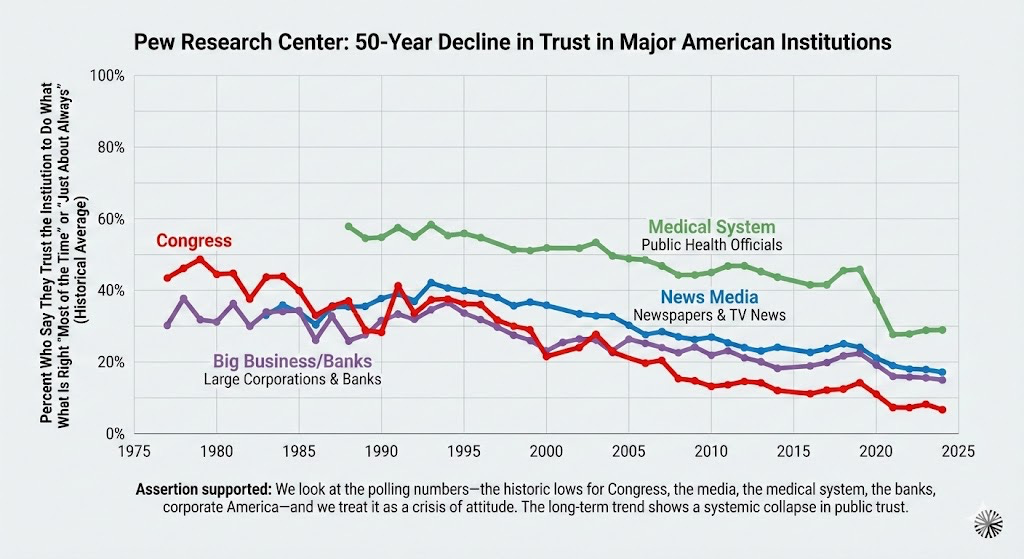
Viewed through the logic of the arbitrary, the collapse of trust reads less like a mood shift and more like a math problem.
Trust is simply a measure of predictive safety. When the inputs—paying the premium, doing the work—stop producing reliable outputs, the prediction model fails.
The data bears this out.
Financial strain is now a stronger predictor of systemic distrust than ideology. When Americans report struggling financially, their trust in federal agencies and corporations drops by double digits regardless of their party affiliation. The stress is universal because the bills are.
Crucially, this distrust concentrates exactly where the mistakes are most costly. The data shows the widest trust gaps in rural and lower-income communities—areas where the margin for error is often zero.
Even where the system appears to work, the fear persists. In recent polling, 69% of Americans reported that it was very or somewhat easy for them to get the health care they needed. A surface read would indicate an important system is broadly working.
Yet respondents to the same survey were given an open-ended follow-up asking them to describe their experiences with healthcare in their own words. The responses were dominated by fear of opaque billing, unexpected costs, wait times, and rushed care. On paper, they have coverage. In practice, they are bracing for impact.
And where trust hasn’t vanished it has been rerouted. In qualitative surveys, people repeatedly describe subscriptions, side hustles, and personal networks as more reliable than formal systems.
That is pattern recognition, not cynicism.
What becomes visible in the current moment is a rational adjustment to a new reality, not a sudden loss of faith. People have discovered, through the steady accumulation of friction, that the systems meant to provide stability have become a primary source of instability.
To ask people to “restore their trust” without fixing the underlying incoherence is to ask them to ignore their own survival instincts. The unease people feel is not imagined. It is the correct answer to a new math. It measures exactly how much risk has been quietly offloaded from the system onto you. This isn’t just a run of bad luck. It is a structural shift that has been compounding for years. And the loss of agency is only one manifestation of this structural shift.
Where else can we feel this structural shift in our lives, what might be driving it, and how could we restore coherence to our social contract. This is the work we are beginning together in America Dreaming.
Suggested Sources
I. The Science: Why “Arbitrary” Hurts
On Procedural Justice Theory (The “Legibility” Argument): Tyler, T. R. (2006). Why People Obey the Law. Princeton University Press.
On Predictive Coding & Prediction Error (The “Hyper-Vigilance” Argument):: Friston, K. (2010). “The Free-Energy Principle: A Unified Brain Theory?“ Nature Reviews Neuroscience and as a secondary source: Mullainathan, S., & Shafir, E. (2013). Scarcity: Why Having Too Little Means So Much.
On Social Pain Theory (The “Status Threat” Argument): Eisenberger, N. I., & Lieberman, M. D. (2004). “Why It Hurts to Be Left Out.“ Trends in Cognitive Sciences.
II. The Data: The “Split-Screen” Economy
Struggling in America in Insights by Murmuration
West Health Gallup Healthcare Indices 2025 Report by West Health
For the long-term trend in institutional trust: Pew Research Center, “Public Trust in Government: 1958-2024” and Gallup, “Confidence in Institutions” Historical Trends (1973-2024)
Note on Methodology: Pew Research Center frequently analyzes and cites this Gallup data alongside its own government trust data in broader reports on institutional decline (e.g., Pew’s Trend magazine, Fall 2024, “Americans’ Mistrust of Institutions”). The graphic effectively combines these two “canonical” datasets to show the synchronized collapse across sectors.
It's more nuanced than that, and probably deserves its own essay. One of the fun things about "trust" is the Pew, Gallup, and others have rich datasets stretching back decades, which allows a lot of analysis. But here's the rough trend.
From ~1980 through the early 2000s, distrust clustered by a combination of party identification, race, education, and age cohort (Vietnam/Watergate effect, post-9/11 effects). Financial strain mattered but as more of a background condition, not as a primary sorting variable. So in simple terms, when I was growing up, people distrusted institutions because of who they were and what they believed, not because they were financially squeezed.
From the ~mid-2000s through the late 2010s, ideology emerged as the dominant frame, particularly drive by Iraq War credibility failures, the 2008 financial crisis, and the partisan sorting of media. This manifested into WHICH institution you trusted and which failures you attributed to malice vs incompetence. So to simplify Ds distrusted the military and business. Rs distorted "the media" and government. Again, in plain terms, ideology/partisanship was often the dominant predictor of institutional distrust.
So what's new is not that ideology has disappeared as a factor but that material conditions have started to overwhelm it as a primary predictor. So today people of different ideologies but similar financial stress report similar levels of distrust, abandonment, and expectations of failure. And you're seeing a lot more "I don't trust anything" as a factor rather than distrust that you can disaggregate into ideological sorting.
The reason this is important is that persuasion, messaging, and coalition-building would an effective lever if distrust were still primarily ideological. But rhetorical alignment is now much less likely to restore trust without material relief. In short, we gotta actually fix the system.
And the people most skeptical now tend to be equally skeptical of private and public sector institutions based on their lived experiences.
“Financial strain is now a stronger predictor of systemic distrust than ideology.” This is such an eye opening line. Does that mean that ideology used to be a better predictor of systemic distrust?